Issue 13: Ornament
Janky Nails in the Expanded Field: Ornament as Telos
The hand
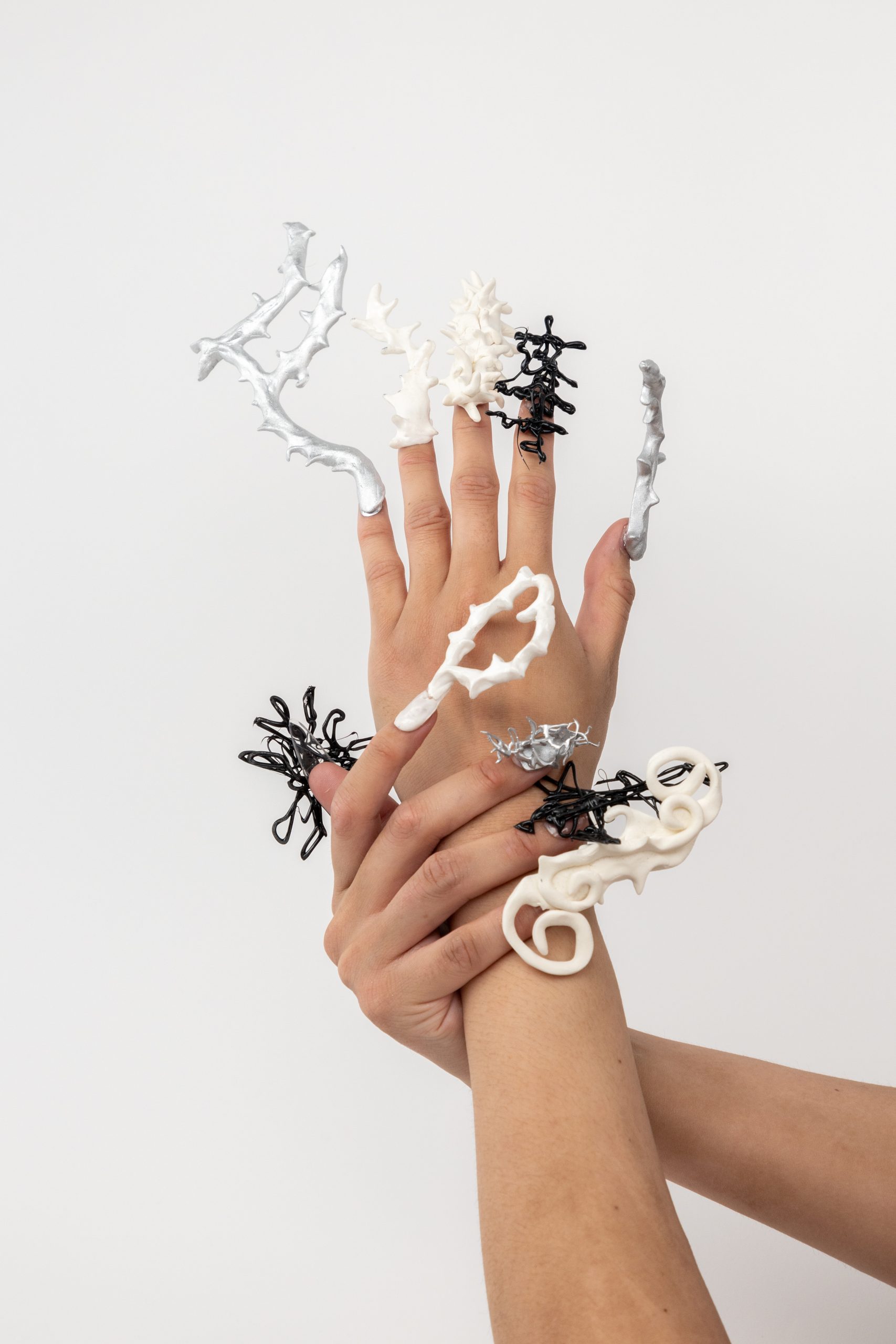
Toward the center of the hand there is a small rise, a swelling of acrylic, an early presentiment playfully given for the presence of the piece. Closer to it, the bevel of chrome’s edge catches the light; a milky translucence breaks into embedded glitter; the cuticle line is sealed as if it were a seam. When the finger turns, the surface turns with it; mirror, then bruise, then pearl. The shape is longer than the fingertip it’s placed on, proceeding slightly beyond the gestures that seem to animate it, making its host slightly late to itself. It makes the simplest task—unzipping a jacket, tapping a touchscreen, prying open a seltzer tab—feel like a negotiation with a tiny architectural prosthesis. The work itself is entirely at the end of the body: part ornament, part apparatus, the boundary between adornment and interface, a delicate structure of polish, glue, and social attention. The piece is, plainly enough, a press-on nail—or wearable sculpture—though calling it sculpture already begins to unveil a wanning stability between the object and its term, like a trick you can see happening.
Contemporary writing on the augmented body often imagines seamlessness: a frictionless integration into the accelerating circuits of late capitalism. Yet, nestled at the terminus of our fingers, another latent potential exists: the ornate, extra-long, or “janky” nail. This medium, at once commonplace and profoundly extraneous, invites consideration into an expanded field of critical inquiry, drawing upon art critic Rosalind Krauss’s spatialization of post-sculptural forms and the chaotic, residual architecture of Rem Koolhaas’s junkspace further developed by Daniel Felstead, Jenn Leung and Maya B. Kronic in today’s jankspace, i.e the mismatched area occupied by our slimy human bodies and the smooth interfaces of our digital lives. To call something ornamental is to express a judgment–a loaded semiotic assessment of purpose that situates the object in relation to the observer’s established framework of utility. It is within this expanded, contested field that janky nails emerge as one potent material intervention, marking the body (reorganizing itself around a narrow extrusion of surface) as a site of disruption against the smooth transmission of digital and social information.
Ornamentum
The hostility toward ornament that shaped twentieth-century design is commonly associated with the Austrian architect Adolf Loos, whose 1908 lecture “Ornament and Crime” framed decoration as cultural regression, a form of wasted labor incompatible with modern industrial production. Ornament appeared in this formulation as a detachable surface excess whose elimination promised aesthetic and moral clarity.
The etymological history of the word complicates that narrative.
The Latin root ornamentum—defined in the Online Etymology Dictionary as “apparatus, equipment, trappings; embellishment, decoration”—suggests that decoration and equipment were not originally conceived as mutually exclusive categories. The ornate nail becomes an apparatus whose telos is ornamentation itself. Its purpose is not an external function (like shelter or conveyance) but the internal, self-referential function of being ornamental, of demanding attention, of generating friction.
Acrylic, gel, chrome powder, rhinestone: these materials gather around the fingertip in a compact assemblage. Surface brilliance organizes attention around the gesture that carries it. At the same time the extension shifts leverage, modifies angles of contact, and repositions the fingertip in relation to the objects it touches, decoration and equipment sharing the same object.
The field
In her 1979 essay “Sculpture in the Expanded Field,” the American art critic Rosalind Krauss utilized a method for thinking about categories that have exhausted themselves. Her “expanded field” diagram transposes its logic from the semiotic square, a structuralist analysis tool also known as a Greimas square after Lithuanian-French semiotician A. J. Greimas, in which a term, its pure contradiction, and their negations generate a four-part conceptual field. Krauss begins with sculpture defined negatively—neither landscape nor architecture—and then restores those excluded poles to visibility. Once the oppositions are mapped, the field of possible forms becomes legible: site constructions, marked sites, axiomatic structures, and the unstable central category that had previously gone by the name sculpture.
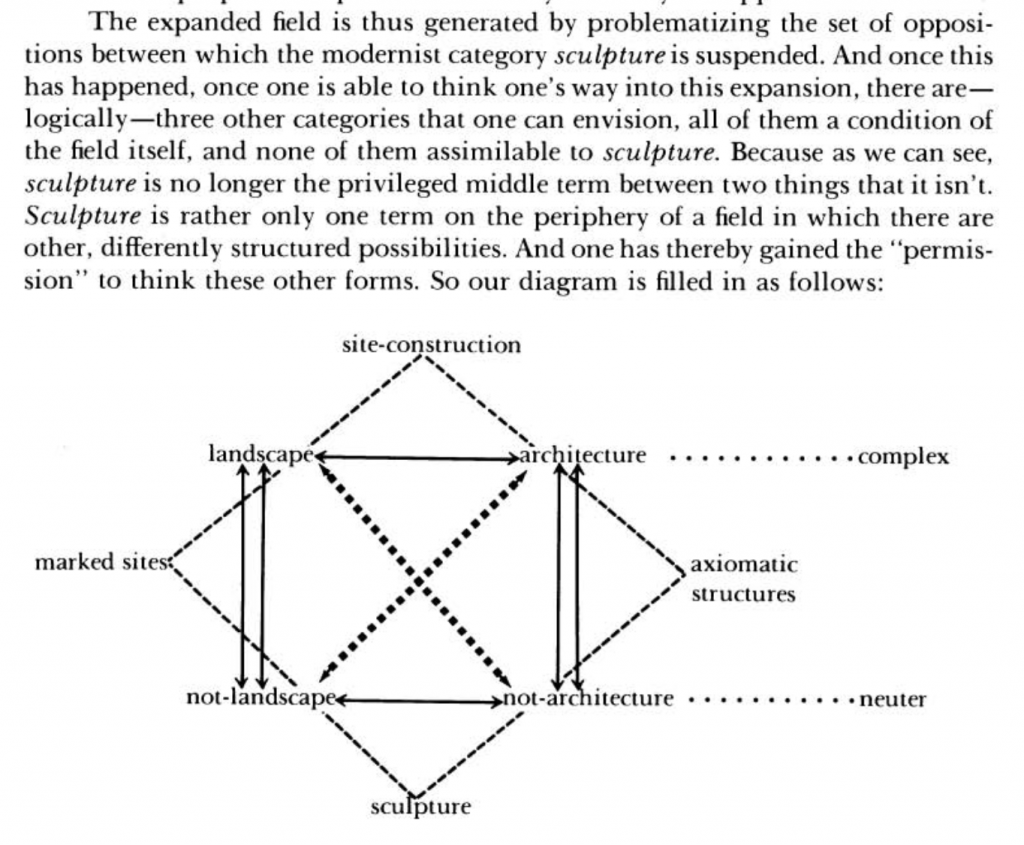
Something similar has happened to ornament. Modern design discourse, especially in the long shadow of Loos’s 1908 denunciation, treated ornament and apparatus as if they belonged to different ontological orders: one attached to spectacle, embellishment, and surface; the other to operation, support, and mechanism. That distinction was always unstable. Still, instability is not the same thing as structure. To say that nails are “both” ornament and apparatus is only the beginning. The more exact claim is that ornament and apparatus now organize a field whose positions are populated by distinct but related practices. The point, then, is less to collapse the two terms than to specify the forms generated by their tension.
The complex term—ornament plus apparatus—would include those practices in which display and operation are openly fused: wearable interfaces, prosthetic fashion, decorative mobility aids, cybernetic drag rigs, luminous stage costumes whose visual excess is inseparable from their technical mediation of gesture, movement, or attention. These are practices that strict modernism could neither comfortably classify nor fully admit, much as Krauss observed that the “complex” remained ideologically prohibited in post-Renaissance art even though other cultures thought it with ease. A body entering this region does not adorn an already given form; it engineers its own appearance as a mode of action.
A second position, ornament plus the space in which apparatus’ negative contours begins, termed not-apparatus, gathers marked surfaces: rhinestone constellations on the face, ceremonial manicures built for imaging more than use, cosmetic inscriptions whose chief effect is to intensify visibility, make the body available to attention, or mark it as site. Krauss’s category of the marked site is useful here not because the body is literally landscape, but because the operative logic is analogous: a surface is inscribed, emphasized, signaled, made to bear meaning through marking. The manicure designed for the camera, for the still image, for the social field of looking, belongs here more than at the complex pole.
A third position, apparatus plus not-ornament, gathers the quieter rigs of support: finger splints, orthopedic braces, accessibility styluses, ergonomic grips, prosthetic tips whose appearance does not seek intensification but whose entire reason for being lies in mediating relation. The philosopher Maya B. Kronic, in the essay “Cute and/or Janky” (2025), offers a framework that becomes useful at this point. Kronic defines the “virtual body” as a vast field of possible configurations, then insists that actual bodies are channeled through historically specific constraints. Jankiness names those improvised attachments and lash-ups through which bodies continue operating where systems architects have not solved the problem. The Uber-driver setup she cites is exemplary: a bricolage of holders, screens, cords, and mounts assembled to bridge the gap between mandated platform protocol and the irreducible mess of embodied labor. Apparatus appears here in a raw state, stripped of glamour, but already halfway to style.
Only after those positions are visible does the neuter term come into focus. This is where the janky nail belongs. Not because it floats above the opposition, and not because it simply synthesizes both sides, but because it suspends their clean separation at the scale of gesture. The long acrylic nail enters the domain of operation by changing leverage, angle, touch, and tempo; it remains insistently ornamental by continuing to solicit attention, surface pleasure, and social reading. In that sense it behaves less like a decorative supplement than like a small, unstable proposition about the body under contemporary conditions. One touches the screen through acrylic. One opens the can tab by strategy. One types at a distance. The gesture has become mediated by a surface whose brilliance is inseparable from its nuisance. The body is neither simply decorated nor simply equipped. It has been rigged.
This is where Kronic’s janky body and Felstead and Leung’s jankspace do their strongest work. In the video essay “Welcome to Jankspace, Babes” (2022), London College of Fashion professors Daniel Felstead and Jenn Leung describe jankspace as the grotesque empty space in the digital network of technocapitalism that slimy human bodies are made to fill. In Kronic’s longer development, jankspace is not only a technical zone but also a felt one: a condition in which neural matter functions like adhesive, patching the last mile between one system and another. Nails, in this framework, read as a minute but telling prosthesis of jankspace. They are glamorous, irritating, meticulous, excessive, and infrastructural all at once. They belong to a world in which bodies are continually recruited to stitch together interfaces that promise seamlessness and produce improvisation instead.
The Dutch architect and theorist Rem Koolhaas had already given that world its architecture in his 2002 essay “Junkspace.” Junkspace, he writes, is additive, layered, continuous, and held together “not by structure but by skin.” It replaces hierarchy with accumulation and composition with addition; it is interior, disorienting, mirror-polished, infrastructural, perpetually revised. Read beside Kronic, the analogy sharpens: if junkspace is the architectural afterlife of modernity’s rational promises, jankspace is its bodily and digital afterlife, the level at which the hand, the thumb, the iris, the cord, the power bank, the payment app, the OTP code, and the patched-together device ecology become the true support system of a supposedly automated world. Nails both decorate that world and register its cumulative excess. They materialize, in miniature, the fact that contemporary embodiment proceeds through temporary, contingent, extended, and negotiated contact.
At this point the opening image returns with a different force. The nail no longer appears as an eccentric object at the limit of the hand. It reads instead as one structurally contingent form among others in an expanded field of ornamentation: one way of redistributing the relation among surface, support, display, and operation. Nails are the entry point because they make the contradiction vivid. They are not the destination. The horizon is broader: prosthetic fashion, technical supports, marked surfaces, wearable rigs, body modifications, all the minor and major ways contemporary bodies become legible and operable by passing through ornament.
Applying Krauss’s diagram as a semiotic square beyond ornament and apparatus reveals more expansive potentialities besides the construction of logical relations. A semiotic square is not just a classificatory device. By tracing a field of tensions generated by contradiction, any two opposed cultural terms can bring their negations into view and open a space in which additional positions become legible. Krauss enacts this through the terms “landscape” and “architecture” to logically suspend “sculpture” in the combination of their exclusions,
If [the] terms [landscape and architecture] are the expression of a logical opposition stated as a pair of negatives, they can be transformed by a simple inversion into the same polar opposites but expressed positively. That is, the not-architecture is, according to the logic of a certain kind of expansion, just another way of expressing the term landscape, and the not-landscape is, simply, architecture.
What can appear as taxonomy holds within itself an engine built for and around structural pressure.
The ornament-apparatus distinction is just one way in which this logic plays out. Once the two poles are placed in opposition, the conceptual terrain between them begins to populate itself with forms that had previously remained indistinct. Some objects intensify display while quietly reorganizing operation. Others stabilize operation while acquiring a surface language of visibility, style, or spectacle. The square therefore functions as a diagram of historical drift. Cultural forms migrate across the field as technologies, habits, and visual regimes change. Surfaces once dismissed as decorative acquire infrastructural roles. Technical supports accumulate aesthetic languages of visibility and style. Practices slide from one quadrant to another as new forms of mediation emerge.
Seen from that perspective, the contemporary landscape of wearable technology, prosthetic fashion, accessibility design, cosmetic modification, and interface customization begins to cohere as a field rather than a set of isolated trends. Bodies increasingly pass through surfaces that operate technically and semantically at the same time. Display and operation become intertwined conditions of mediation.
Nails occupy one small coordinate within this broader transformation. Their significance lies in the clarity with which the contradiction appears. A surface designed for attention mediates contact. A gesture reaches the world by passing through decoration.
The diagram does more than classify the manicure. It outlines the structure in which the manicure becomes intelligible. Ornament no longer appears at the margins of function awaiting elimination. It emerges instead as one of the mechanisms through which contemporary bodies, objects, and interfaces negotiate their relation to one another.
In that sense the expanded field of ornamentation may only be beginning to come into view.
References
Felstead, Daniel, and Jenn Leung. “Welcome to Jankspace, Babes.”
Koolhaas, Rem. “Junkspace.” October 100 (2002).
Krauss, Rosalind. “Sculpture in the Expanded Field.” October 8 (1979).
Kronic, Maya B. “Cute and/or Janky.”
Loos, Adolf. “Ornament and Crime.” 1908.