
Issue 13: Ornament
The “Ornament’s” Lament—In my past lives, I was once a dead christmas tree
When I say that I am wishing for a green Christmas, I am fantasising about a world where the existence of a tree is not attributed less value than the need to decorate one’s house for a month or so. A world, where the life of plants deserves human respect, as opposed to fetishised veneration followed by transformation into waste. One, where meaning and sense are located not only in our spiritual pursuits but also in the bodies of every human and non-human, animate and inanimate, being.
— Michael Marder, I Am Dreaming of a Green Christmas.

Touch Me With Your Green
It’s just an ordinary day in Berlin. After the holiday season, the city still enjoys its rare quietness—a lingering hush before the rush of modern life resumes. A stream of unusually bold sunlight peeks through my window, calling me to step out of my cocoon.
No clouds. Clear sky.
I am taking a walk around Neukölln, the Berlin neighbourhood I call home, enjoying the precious moment of sunshine caressing my skin, when bits of coloured green spark my vision. Like jaded stars, the green glows particularly luminous against the snow-dusted cityscape.
What is this? Is spring already coming?
Out of curiosity, I walk toward the greenness that has called me— Pine trees?!
Surprised, I keep walking and discover that at almost every street corner, discarded pine trees lie on the curb. Sometimes they appear in pairs, sometimes alone. Their trunks are cut; some plastic decorations, now eroded by half-melted snow, still dangle from the branches like post-holiday depression.
Have you ever experienced that moment when, once you start noticing something, the world suddenly mirrors it back at you everywhere? This was that moment—when I realised the uncanny truth of my surroundings. I am standing in a graveyard of countless Christmas used-to-be-trees. These pine bodies are discarded like garbage after their holiday purpose is fulfilled. Stripped of identity, of dignity, of the hands that once decorated them…
And yet.
And yet their evergreen branches still shine softly, touched by the winter sunlight. Stubbornly thriving, they deliver their final gift—the colour of hope. For being evergreen is not something they perform. It is something they are.
As their green consciousness flickers softly before the living, I wonder: what would they say of the humans who once brought them home?
Vegetal Beings As Ornament
子曰:「岁寒,然后知松柏之后凋也。」
— Confucius, Chapter 28, Book IX (子罕), The Analects 論語1.
In The Analects, “the Master said: ‘Only when the year grows cold do we see that the pine and cypress are the last to fade.’” What Confucius really reflects here is to regard pine and cypress as the embodied figuration of resilience. Very often in the sino-sphere, pine and cypress are celebrated as the preserving spirit for their unyielding nature. The promise of green when all else has withered makes pine become the guardian of longevity and perseverance. In the west, the stubborn green and quiet endurance also bring pine as a crucial part of Christmas tradition.
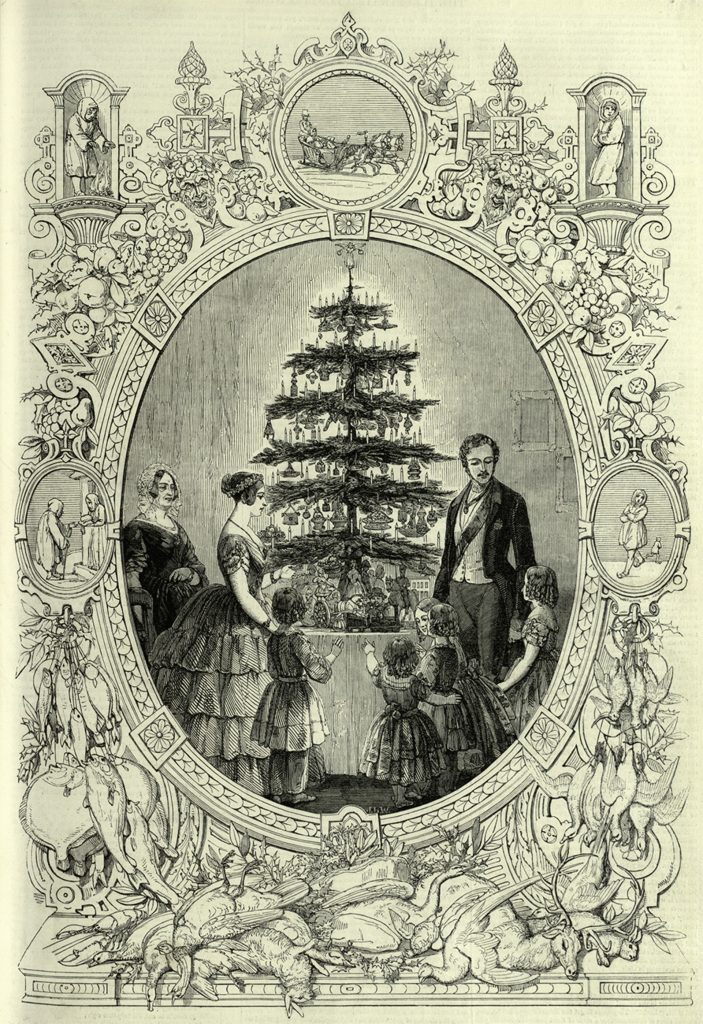
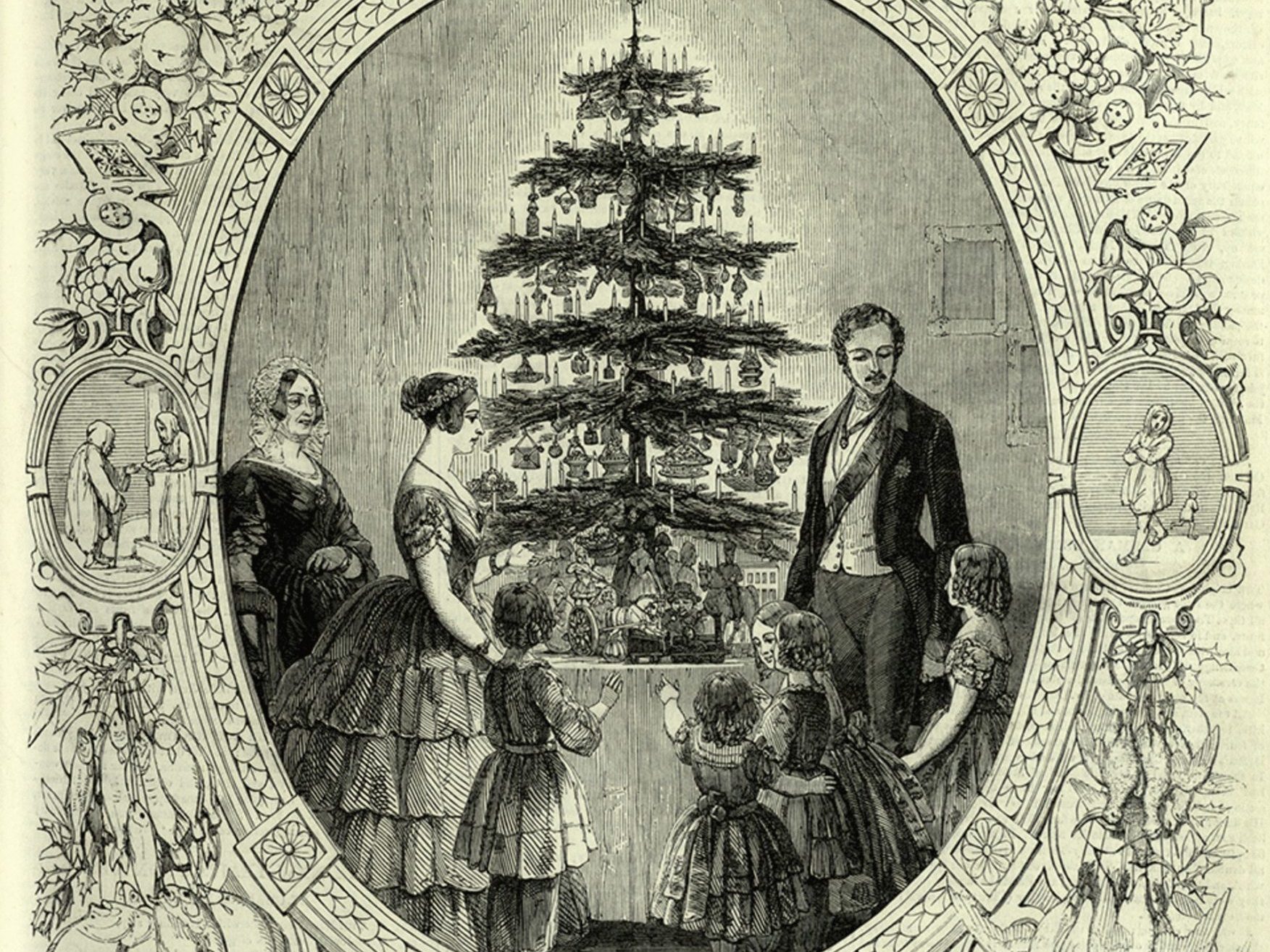
The history of the Christmas tree reaches back through time: from pagan winter solstices honouring evergreen boughs as promises of life’s return, to medieval mystery plays where the “Paradise Tree” hung with apples represented the Garden of Eden. The tree of Christmas used to be a living wish embalming with hope and light in the darkest season. In 16th century Germany, the Christians started to bring decorated trees into their homes. By the 19th century, the tradition had spread across Europe and beyond. Somewhere along this journey, something shifted. While the world ventures into its wild modernity, this living wish became a seasonal fashion, as introduced by Queen Victoria’s German husband Prince Albert, depicted in Windsor Castle in 1846. The being whose spirit was once honoured became an ornament—something that adorns, that beautifies, that serves a human purpose.
In our current times, though perhaps “ornament”3 is still too generous a word.
There is a difference, after all, between an ornament and a decoration. An ornament implies something of value—a hand-blown glass ball packed away carefully each year, a carved wooden angel passed down through generations. It carries memory. It is kept. A decoration, by contrast, is temporary. It is the plastic tinsel that tangles and tears, the mass-produced snowflake that ends up in landfill. It enhances a moment and is then discarded, without a second thought. Its purpose is purely for the human eyes in the moment, and when the moment passes, it becomes nothing. In this way, the tree on the curb is not an ornament. As an ornament, perhaps, the tree would be treasured, remembered, cared for. The tree on the curb is a discarded decoration—something that once served its purpose and is now trashed.
Across Europe, 50 to 60 million Christmas trees are sold each year. In Germany alone, the Christmas tree market is valued at 2.1 billion dollars. In France, approximately 6 million natural trees are sold annually. In the United States, according to the National Christmas Tree Association (NCTA), another 25 to 30 million real trees enter homes annually. In London, the borough of Wandsworth collected 13,000 discarded trees this past January—212 tonnes of pine, composted into agricultural fertiliser. If they are lucky, the pines get a chance to return to the soil. For the ones dumped on the pavements or in the canals of the modern cities, there is no actual record keeping track of their afterlife.
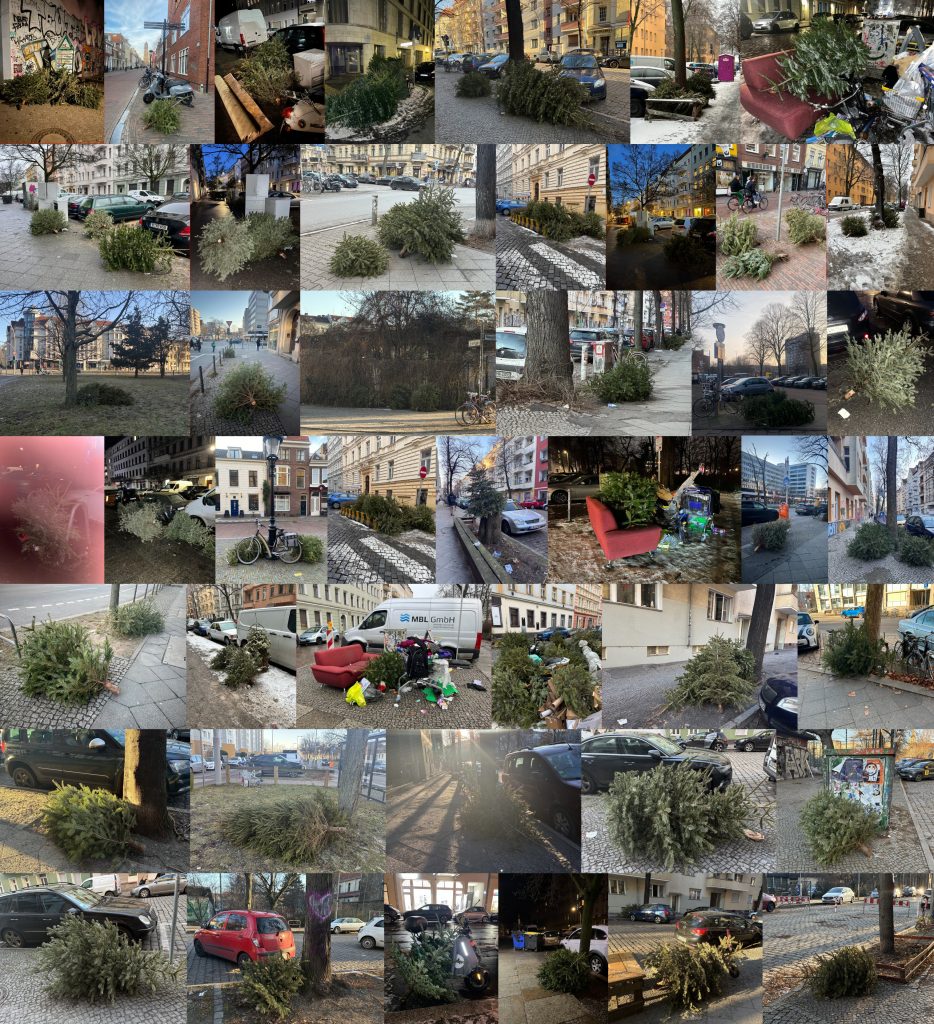
What do these numbers tell us? Perhaps they are so large that they become abstractions. Yet the christmas trees I’ve encountered at the street corners grounds the abstraction of these numbers. As the picture collage shows, what you are looking at is merely a small snapshot of the tens of millions Christmas trees sold (and discarded). In facing these bodies, we must confront the fact that we, the modern human, have reduced a living being into decoration, its death normalised.
Phenomenon as such is not just coincidence, but proudly reflects how the modern human creatures develop their relationship with vegetal beings. In 1999, botanists Elisabeth Schussler and James Wandersee gave this phenomenon a name — “Plant Blindness”. They defined it as the inability to see or notice plants in one’s environment—to distinguish the different varieties, to appreciate their aesthetics—together with the tendency to consider them as inferior life forms to animals4. A kind of cultural myopia that renders the green world invisible, a mere background to the anthropocentric drama we call life.
Philosopher Matthew Hall deepens this diagnosis. He argues that the reasons we fail to regard plant life as equal to our own are predominantly cultural. We tend to see plants as raw materials, as sources of food, as decoration. This marginalisation, he maintains, is neither natural nor inevitable. It has less to do with physiological bias than with a zoocentrist attitude running through Western thinking—a tendency to separate, exclude, and hierarchise species5. Plants, in this framework, become objects with no consciousness. They become materials that serve human purposes. They become, in the most literal sense, ornaments —if they are lucky.
The “Happy Daydreams”
Le végétal tient fidèlement les souvenirs des rêveries heureuses. Achaque printemps il les fait renaître.
— Gaston Bachelard, L’air Et Les Songes6.
When Gaston Bachelard writes about the “happy daydreams” of plants, he himself was not dreaming. As a philosopher of the elements, it is not surprising to know that Bachelard’s vegetal vision is deeply rooted in the belief that the green world senses, remembers, grows and regenerates from its sentient entanglements with the living earth.
This understanding is not new. The idea that plants hold profound intelligence—as ancestors of almost all living beings on this earth—has been central to numerous Indigenous and animistic societies since time immemorial, including those early dwellers on the European continent. For these traditions, plants are active agents in the web of life: teachers, healers, kin. It is what Hildegard Von Bingen calls “viriditas”, that is, the pulsating “Greening Green”, elucidated by philosopher Michael Marder, “the holy spirit as a root shared by all creatures.”7
Monica Gagliano’s research has given empirical confirmation to these belief systems. Gagliano’s experiments with Mimosa pudica showed that plants learn from experience, that they remember, that they distinguish self from non-self. In low-light conditions, where closing leaves meant losing precious energy for photosynthesis, they learned faster and held the memory longer. They assessed the situation. They made a choice. In another study, pea seedlings learned to associate a neutral stimulus—a breeze—with light, and grew toward it. Classical conditioning, once thought exclusive to animals, happening in beings without (the overly celebrated) brains.
If a mimosa can remember being dropped, what might a pine remember of the hands that decorated it? If pea roots can hear water flowing underground, what did these trees hear in the rooms where they stood—carols, arguments, children whispering secrets to their branches? In this way, Bachelard’s “happy daydreams” of plants become a precise description of what vegetal beings do — plants daydream. And within these daydreams, plants see, hear, smell, taste, touch, speak, weave memories into fables of this planet.
I think again of the trees I passed this morning. I walked closer to one of them, gently touched one of its branches that are still vibrant in its green glow. I can’t help imagining, for a few weeks, this little tree stood in someone’s home. Its branches held lights. Its scent filled the room. Children placed ornaments on it. Gifts appeared beneath it. Photographs were taken in its glow. Perhaps a cat napping under its shade. It was the silent centre of a family ritual, the still point around which the season’s warmth gathered.
And now it lies on the curb. How far is the distance from that center of warmth into this cold shadowy corner? I also cannot help but think about the fact, according to Gagliano, that plants do possess memory. These trees carry within them the traces of those weeks. They remember being taken. They remember being held and ‘decorated’. They remember being loved and cared for. They remember the voices, the laughter, the warmth. And they remember being carried to the curb and left.
This abandonment is a double loss. When the pine is left on the street, the human also abandons a part of their own memory, sensation, and experience. For weeks, the tree was not an inert object but a silent participant: its scent shaped the air, its branches held cherished lights, and its presence framed gatherings. It was a guardian of those momentums, the guardian of the season’s intimacy.
In this way, the lonely vigil of the dead pines on the pavement is not just a symbol of our wastefulness, but a testament to a forgotten kinship. In other words, our souls are blind, and along with the absolute linear logic of the so-called ‘progress’, we forget about our own becomings that have never been straight.
Every Pine is a Spirit
What might it be like “see” ourselves in the very process of becoming blind to our own souls?
— Eduardo Kohn, How Forests Think-Toward an Anthropology beyond the Human.
There is something else we forget, something even more fundamental —Trees do not die as we do.
Scientists who study tree mortality speak of “programmed cell death”. It is not a passive collapse, but an active, genetically regulated process that every tree carries within itself, ready to be activated when needed . In xylem development, the death of woody cells unfolds slowly, progressively, with organelles removed from the cytoplasm long before the final moment of cellular collapse. For xylem fibres in particular, death is not a sudden end but a gradual autolysis, a self-digestion that can last for weeks or months. Again, this is not something that happens to a tree. It is, just like daydreaming, something a tree does.
Different species die differently. In European forests, some trees show sudden mortality while others decline slowly over decades before finally dying. Scots pine may die abruptly; silver fir fades gradually, its growth slowing year by year until it can no longer hold on. The death of a tree is as individual as its life.
And in natural forests, dead trees are not endpoints but beginnings. They become snags that house woodpeckers, logs that feed fungi, nutrient stores that cycle through ecosystems for decades or centuries . The suitability of a dead tree as habitat depends partly on the causes of its death—different mortality factors open different decomposition pathways, creating diverse opportunities for new life . As one study notes, dead wood changes over time in successional patterns, its structure and function evolving long after the tree itself has ceased to live .
Trees die tree deaths. Their decay feeds soil. Their nutrients return to earth. Their cells become something else. The memory they carry does not simply stop; it transforms, dissolves, re-enters the great green circulation of vegetal becomings. And this brings hope because the pine’s story does not end at the moment when it is forcefully removed from its roots nor being discarded on the curb. The pine shows us the very resilience of the natural world through its own embodiment, just like that green shimmers illuminating the bleak Berlin winter caught my eyes.
Every pine is a spirit.
To sense this is to recognise a kinship that is rooted in the soil of our very nature. We are not merely like the discarded trees. In our own cycles of being cherished and outgrown—in our own mortality, our own silent witnessing, our own longing to be more than decoration—we are that vegetal being. The pine’s quiet demise asks us to dismantle the hierarchy between observer and ornament, between human and plant. It asks us to recognise a shared, conscious fragility. It asks us to see, in the discarded greenery, not waste, but our shared existence.
Spirits return. They reincarnate. They come back in different forms, carrying the memory of what they were into what they become.
What would these pines reincarnate into?
Perhaps next time, they return as something we cannot so easily discard. Perhaps they return as roots that hold the earth together, as oxygen in the air we breathe. Perhaps they return as us, as me, writing down all of the memories that have been entrusted into my body.
And then, in some future winter, when I lie on my own final cosmic curb, I will remember—faintly, greenly—that I too was once a tree. And I will hope that when I return, I would be a forest on an evergreen purple planet.
- The master said: “Only when the year grows cold do we see that the pine and cypress are the last to fade.” ↩︎
- Engraving from the Illustrated London News showing Queen Victoria and Prince Albert around the Christmas tree, 1848, England © British Library Board. P.P.7611. ↩︎
- I have noticed that in the old drawings of Christmas tree, the trees were mostly planted in a pot, as oppose to the ones being abandoned on streets nowadays. ↩︎
- James H. Wandersee and Elisabeth E. Schussler, “Preventing Plant Blindness,” The American Biology Teacher 61, No.2 (February 1999): 82-86. ↩︎
- Matthew Hall, Plants as Persons: A Philosophical Botany, Albany, NY: SUNY Press, 2011, 6. ↩︎
- “The plant faithfully keeps memories of happy daydreams. Every spring, it gives them a new birth.” (Michael Mardar’s translation of Gaston Bachelard’s Air and Dreams). ↩︎
- Marder, Michael. Green Mass: The Ecological Theology of St. Hildegard of Bingen. Stanford University Press, 2021.
↩︎ - These pictures are captured by CROSSLUCID, Josie Ulbrich, Laila Fakori, Leo Eckert, Lou Drago, Sabiwa, Tǎňa, Tian Guoxin, Rosa Stigter and myself. While most of the pictures are taken in Berlin, there are several from Prague, Amsterdam and Utrecht. ↩︎
References
Bachelard, Gaston. L’air et les songes. Paris: José Corti, 1943.
Batllori, E., et al. “Forest and woodland replacement patterns following drought-related mortality.” Proceedings of the National Academy of Sciences, 2020.
Bundesverband der Weihnachtsbaumerzeuger in Deutschland. Data cited in German news media, 2024.
Businesscoot. “The Christmas Tree Market – France.” October 2022.
Courtois-Moreau, C. L. “Programmed Cell Death in Xylem Development.” Doctoral thesis, Umeå University, 2008.
Doronina, T. V., et al. “Plant programmed cell death in the context of diversity and evolution of PCD.” Protoplasma, 2025.
Gagliano, Monica, et al. “Experience teaches plants to learn faster and forget slower in environments where it matters.” Oecologia, 2014.
Gagliano, Monica, et al. “Learning by Association in Plants.” Scientific Reports, 2016.
Hall, Matthew. Plants as Persons: A Philosophical Botany. Albany, NY: SUNY Press, 2011.
Hunter, M. L. “Dying, dead, and down trees.” In Maintaining Biodiversity in Forest Ecosystems. Cambridge University Press, 1999.
Idoate-Lacasia, J., et al. “Trends in background mortality in unmanaged forests across Europe over the last century.” Journal of Ecology, 2025.
IndexBox. “EU Christmas Decoration Market Report 2026.” Market research report.
Kohn, Eduardo. How Forests Think: Toward an Anthropology beyond the Human. Berkeley: University of California Press, 2013.
Marder, Michael. Green Mass: The Ecological Theology of St. Hildegard of Bingen. Stanford, CA: Stanford University Press, 2021.
Marder, Michael. “I Am Dreaming of a Green Christmas.” Substack, December 2024.
Marder, Michael. Plant-Thinking: A Philosophy of Vegetal Life. New York: Columbia University Press, 2013.
New Forest District Council. “Christmas Tree Recycling Results.” Official press release, January 2026.
Stokland, J. N., Siitonen, J., & Jonsson, B. G. “Natural forest dynamics.” In Biodiversity in Dead Wood. Cambridge University Press, 2012.
Wandersee, James H., and Elisabeth E. Schussler. “Preventing Plant Blindness,” The American Biology Teacher 61, No. 2 (February 1999): 82-86.
Wandsworth Borough Council. “Christmas Tree Collection Report.” Official press release, February 16, 2026.