
Intentions:
My intentions for this project were to create a map style guide that highlights various tourist attractions within the Korean DMZ. I wanted to use the metaphor of a museum map to show how an area which is known for being dangerous has transformed into an attraction that people actively go to to sightsee and enjoy.
Another intention was to show the return of wildlife to the area. A lot of vulnerable and endangered species have thrived in the DMZ with the absence of human presence and lack of development. Now, they are becoming a tourist attraction which will increase human presence and potentially cause harm to their new ecosystem.
Research:
I started my research with two systems maps. The first was a mind map to help organize my thoughts and the second was a casualty loop which illustrates some of the tension inherent to DMZs.
From the systems map, I thought I was going to focus on doing some sort of war map or realistic map of a specific DMZ. I chose the Korean DMZ since it’s the most dangerous places in the world. When I started diving deeper into that particular DMZ, I discovered a branch of stakeholders that I had completely overlooked – tourists!
Link to systems map: https://itp.nyu.edu/lowres/critex-monika/2022/09/19/systems-map-dmz/
Link to interview: https://itp.nyu.edu/lowres/critex-monika/2022/09/26/topic-1-interviews/
Making the Guide:
For my guide, I wanted to create a museum style map to evoke the feeling of exploring an exhibition. Typically we think of tourist destinations as relatively safe areas where people go to rest and relax. I wanted to turn that on its head a bit since the DMZ is completely the opposite. It’s a very dangerous area. There’s tons of security and military personnel on the DMZ borders and physical dangers within, like landmines.
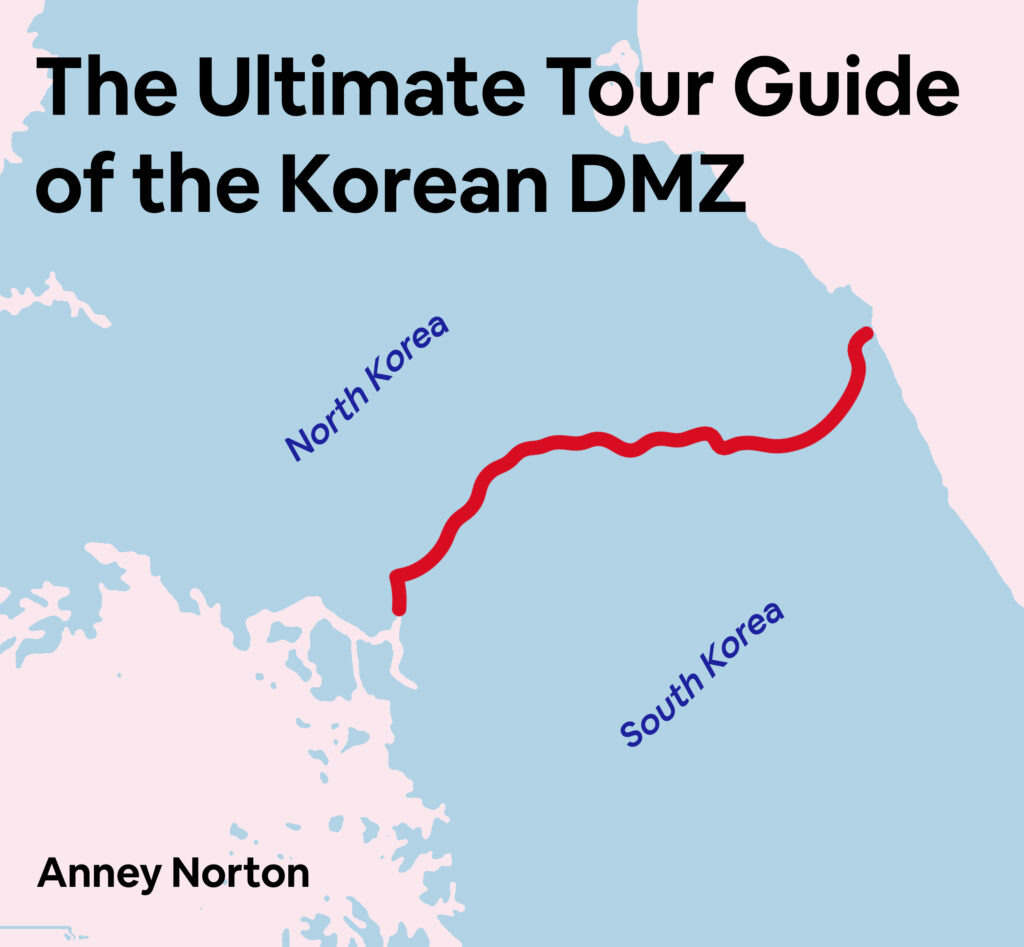
The map consists of a cover page with a realistic map noting the location of the Korean DMZ. The floor maps are stylized to bordered rectangles, some with dark lines noting various “rooms”.
The first floor showcases wildlife, highlighting the best areas to go to to see endangered birds, deer, bears, foxes, and more. The Korean DMZ lacks a human presence, so many of these animals are able to thrive in peace. The irony is, of course, that people are now actively going into the DMZ to find and watch the wildlife.
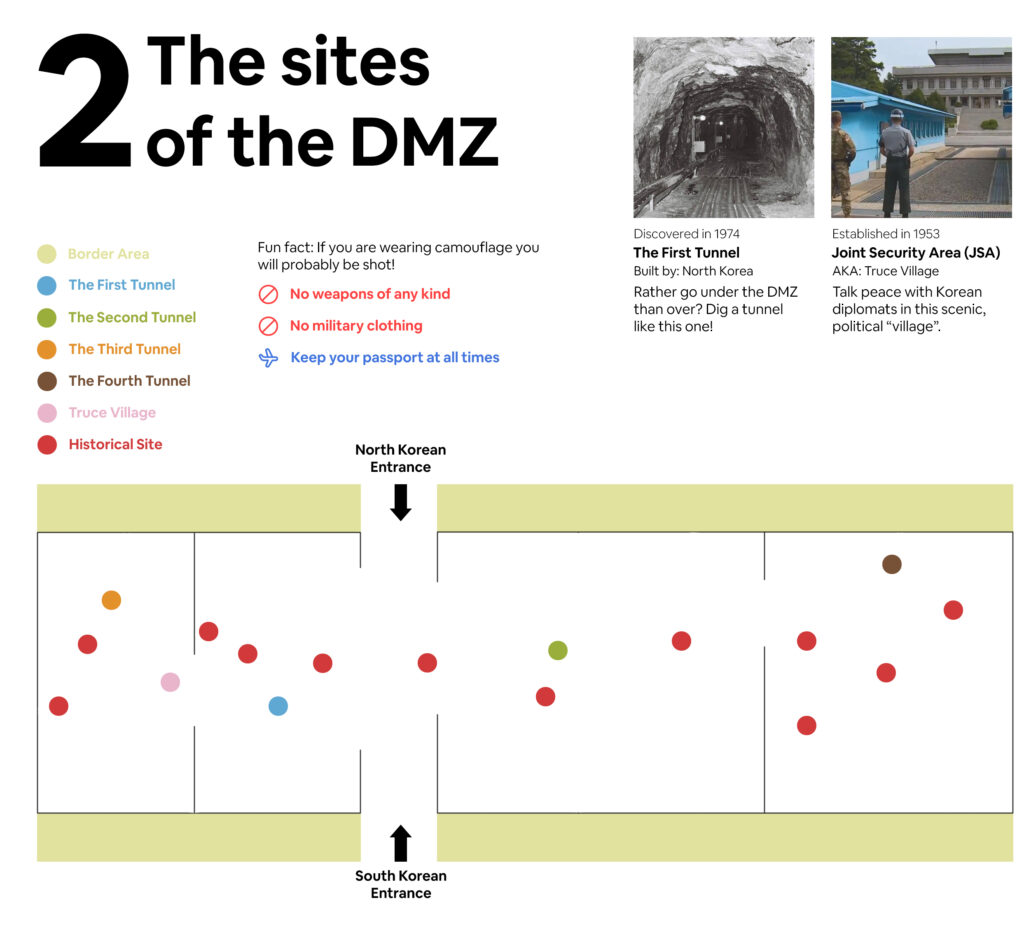
The second floor is a historical sites map. Most of the sites are areas where famous battles took place. Others are temples, palaces, tunnels, and Truce Village (where North and South Korean diplomats meet).
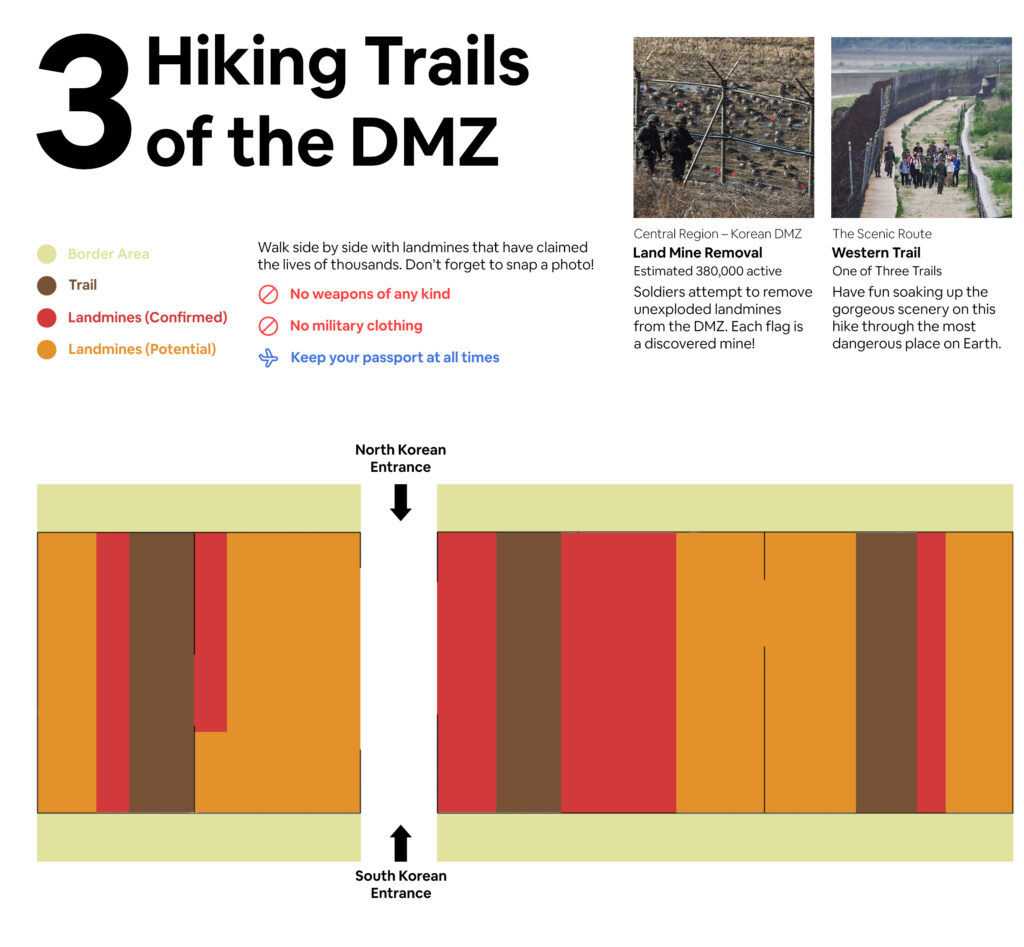
The third floor displays three new hiking/walking trails that were recently established within the DMZ. All of the trails pass near active minefields, though they are said to be landmine free themselves. I thought showcasing the closeness of the trails to the landmines is an effective way to illustrate how dangerous the area is. It’s honestly shocking that people actively go to walk directly next to unexploded landmines for a photo op.
Sources:
Wikipedia:
https://en.wikipedia.org/wiki/Demilitarized_zone
https://en.wikipedia.org/wiki/Korean_Demilitarized_Zone
Trip Advisor:
https://www.tripadvisor.com/Attraction_Products-g1872665-d2076201-DMZ-Paju_Gyeonggi_do.html
NPR:
https://www.npr.org/2019/04/20/710054899/in-korean-dmz-wildlife-thrives-some-conservationists-worry-peace-could-disrupt-i
https://www.npr.org/2019/08/27/754811189/hundreds-of-thousands-of-landmines-remain-from-korean-war-but-serve-no-purpose
Asia Society:
https://asiasociety.org/korea/koreas-dmz-offers-safe-haven-diverse-wildlife-now
Washington Post:
https://www.washingtonpost.com/world/asia_pacific/wildlife-thrives-among-the-land-mines-along-koreas-dmz-but-for-how-long/2019/08/27/ef76f3fe-c29e-11e9-8bf7-cde2d9e09055_story.html
Korea Herald:
https://www.koreaherald.com/view.php?ud=20191028000683
Reuters:
https://www.reuters.com/article/us-northkorea-southkorea-dmz/north-south-korea-begin-removing-landmines-along-fortified-border-idUSKCN1MB1BG
Korea Times:
https://www.koreatimes.co.kr/www/culture/2022/08/141_334629.html
LA Times:
https://www.latimes.com/world/asia/la-fg-koreas-peace-trail-20190625-story.html
Hi Anney, after looking your guide, I feel your really did a lot of research on Korean DMZ. For me, your form of guide is really suitable for presenting the condition of these area. Your museum map has a sense of humour and satire cause usually a tourist map or museum map shows a peaceful or fun tourist attractions, but your map presents a human-made dangerous zone. The Korean DMZ should not exist and human changed the areas’ ecosystem. Many people and animal died because of the Korean DMZ, and it is still affecting the social and natural surrounding environment. One problem for me about your guide is it lacks of user interaction. If you could make some interactivities in your guide, it will be more fun.
Anney!
I was so excited to see where you were able to take this project. It is both visually well done, and the level of satire and complexity you achieved with this specific form was very impressive. It was not an easy topic, and you succeeded in making the material both intriguing and informational.