Infrastructures of Distance, or the Logics of Thinning and Thickening
Nasif Rincon Romaite
Advisor: Luisa Pereira
A study of how the internet infrastructure shapes our relationships—and a tracking tool to observe it in real time.
Project Description
Infrastructures of Distance is a practice-based investigation into the social affordances of the internet. The project introduces two infrastructural conditions, Thinning and Thickening, as a framework for examining how internet-mediated communication shapes our interpersonal relationships.
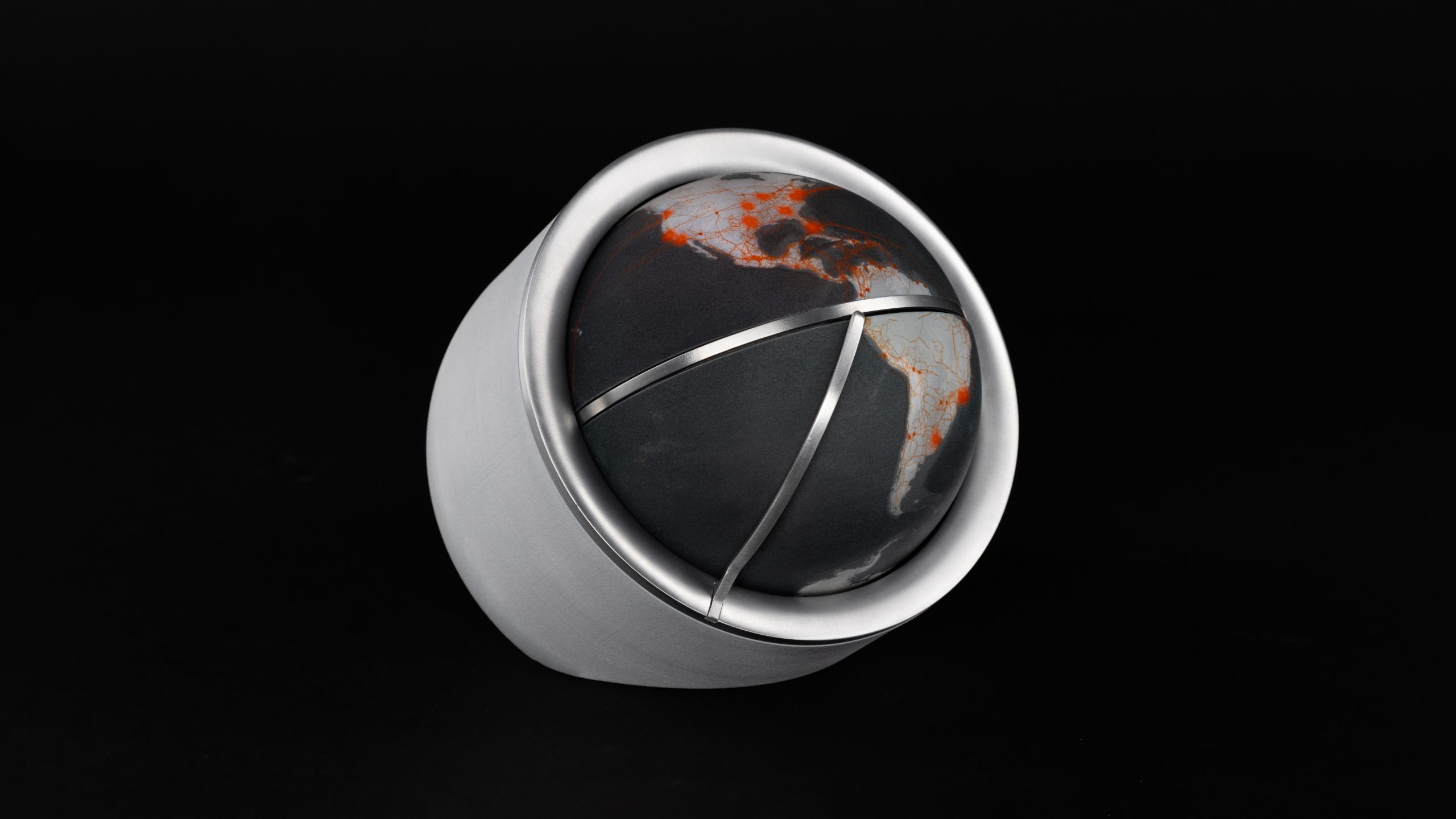
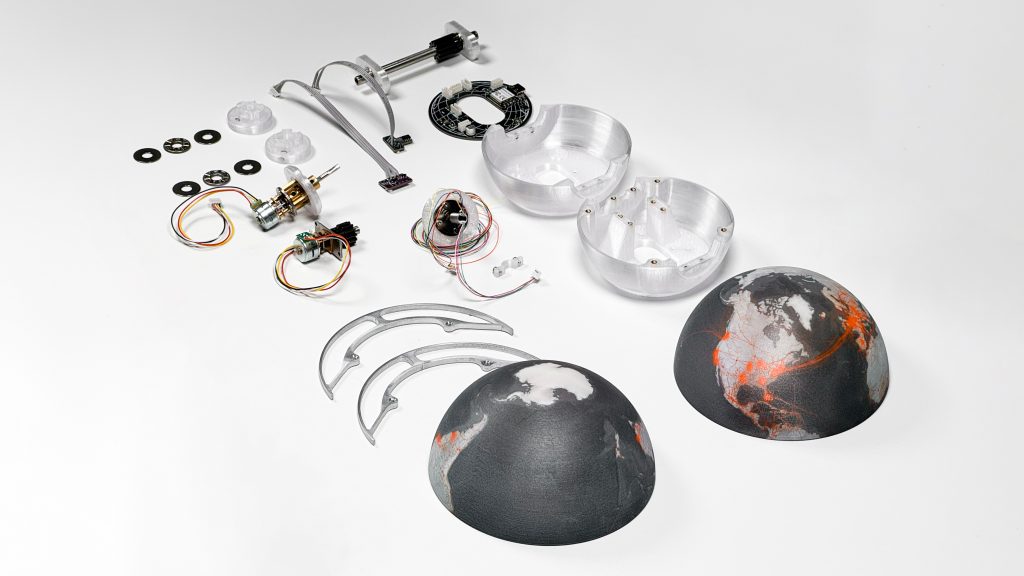
At the center of the work is the Fiber Navigator, a custom-built network visualization instrument that functions simultaneously as a home internet router and as a research device. By visualizing and recording network connections in real time, it seeks to render the normally invisible operations of internet infrastructure both perceptible and subject to scrutiny.

Technical Details
The Fiber Navigator is a custom tracking instrument developed to visualize and extend the research. At its core, it functions as a home internet router: when connected to the network via cable, it creates a WiFi hotspot that can be used by other devices, such as phones and laptops. As users browse the web, their connections are geolocated on the globe visualizer while being stored in a local database.
By analyzing the collected data, the research may develop into a continuing practice. One concerned with identifying other infrastructural dynamics that shape our relationships, beyond the Thinning and Thickening described below.
As a tool, the Fiber Navigator becomes both a passive indicator, visualizing our connections in the background, and an active probing instrument, allowing us to scrutinize network behaviors and their impact on our lives.
Research/Context
Personal connection is understood through a deeply rooted metaphor of distance. This is evidenced in our language, with phrases like “stay in touch”, “how can I reach you” or “making contacts”. And yet, we succeed at maintaining social intimacy despite distance, to the point of developing systems and technologies that afford instant connection across the globe.
However, nobody would claim that connection over the internet is the same as being in person. Beyond the immediately apparent difference of lacking physical contact, what else differs? What is made impossible by these infrastructure-mediated relationships? What is only possible through them? And how do these affordances impact our experience of the world and each other?
In this research I identify two key conditions of internet-mediated-relationships that emerge from these affordances: Thinning and Thickening.
ᴛʜɪɴɴɪɴɢ
“The biggest challenge to developing telepresence is achieving that sense of ‘being there.’ Can telepresence be a true substitute for the real thing?”. This was the key question asked by Minsky in his 1980 Telepresence manifesto. Forty years later we have achieved instant video calls across the world and continue to develop technologies that make telepresence resemble presence, like MIT’s TRANSFORM or Emerge’s Wave-1. But one thing has remained the same: humanity must be converted into data for transmission. Bodies are reduced to pixels, voices to audio. This reduction is an imperative of the internet infrastructure, and it highlights a condition of the internet which I call Thinning: The internet affords the shortening of distance at the cost of diluting presence.
ᴛʜɪᴄᴋᴇɴɪɴɢ
Waymo’s driverless cars are often “guided” by workers in the Philippines. Amazon’s Cashierless stores are managed by remote cashiers in India. 1X’s NEO robot is frequently teleoperated by remote housekeepers. What were once local interactions with drivers, cashiers or housekeepers can now be replaced with teleoperated ones, providing the luxury of social detachment from the workers who make these services possible.
This is a particular form of Ghost Work: a strategic erasure of the workers we interface with in everyday situations. This is the condition I call Thickening: the internet affords the thickening, or enlarging, of distance as a means of obfuscation. Rendering interactions more opaque and less human.
These conditions, afforded by the internet infrastructure, shape our world and the ways we relate to one another. By recognizing them, we may become more capable of identifying them in daily life and recovering some agency over how we maintain relationships with those around us, both close and far.
This text is an abridged version of the project’s research. For a more detailed essay, please visit the project website linked at the top of this page.