the soft computer
Yafira Martinez
Advisor: Sarah Ibrahim
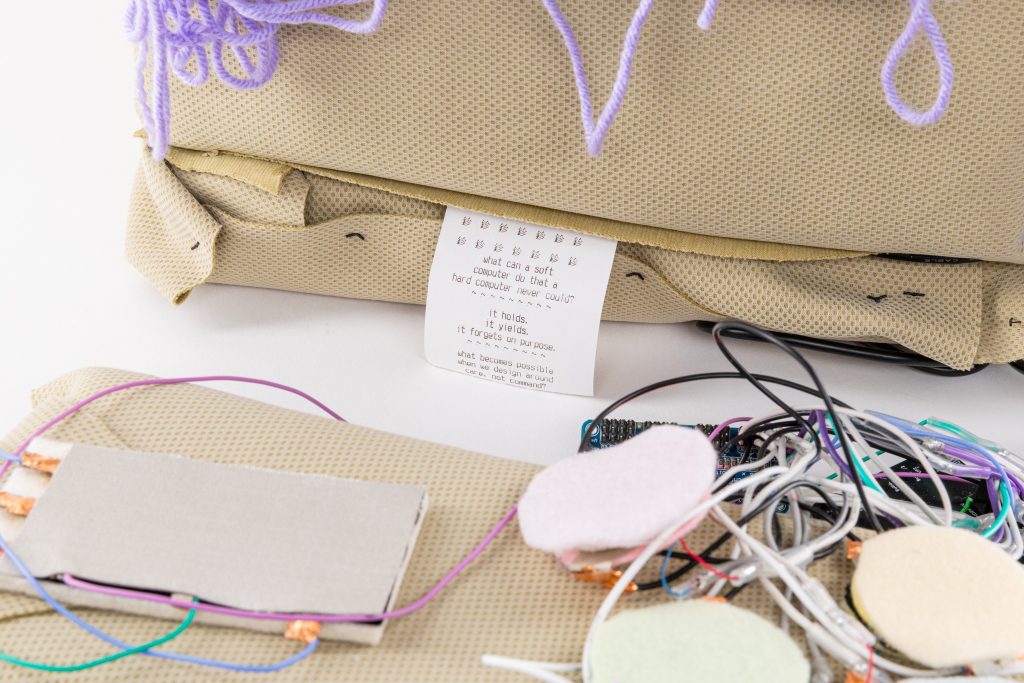
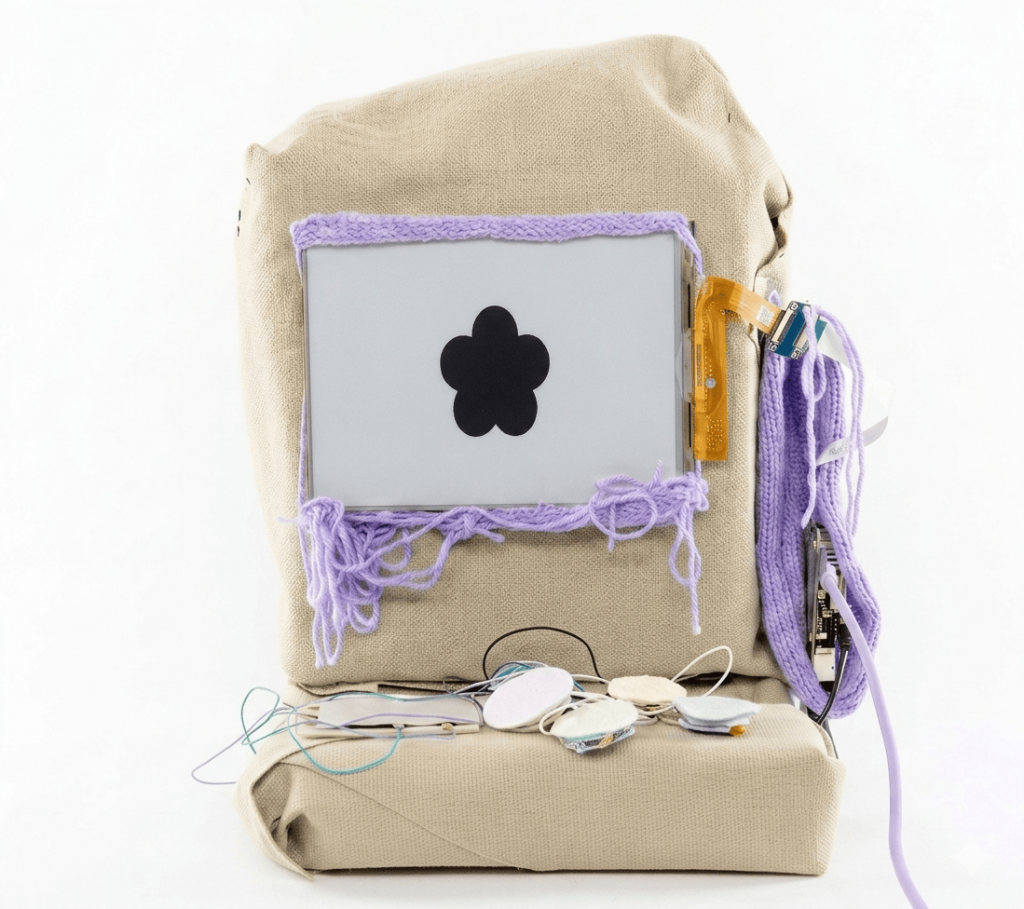
The Soft Computer is a textile-based computing object that senses touch, generates poetry, and outputs physical receipts. It asks what becomes possible when we design computers around softness rather than hardness, around care rather than command, and around material presence rather than digital abstraction.
Project Description
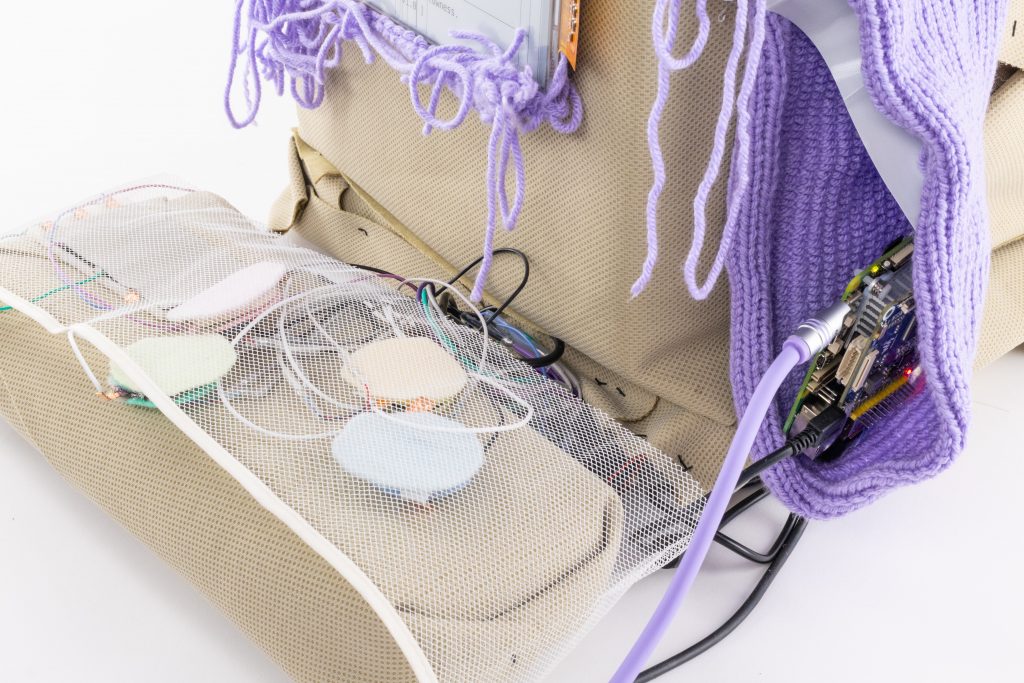
The Soft Computer is a textile-based computing object that imagines a gentler way of being with technology. Constructed from soft materials with machine-knit accents, it houses a flexible e-ink display, capacitive touch zones, a haptic motor, ambient sound, and breathing light, all enclosed in something you can hold in your lap.
It is designed to be sat with, not operated.
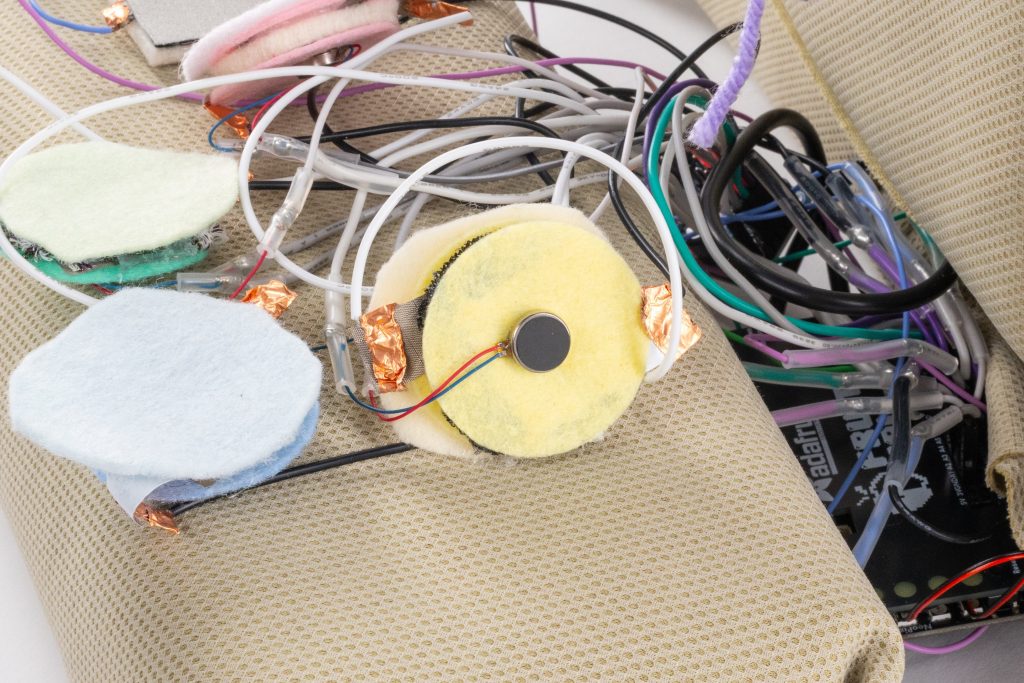
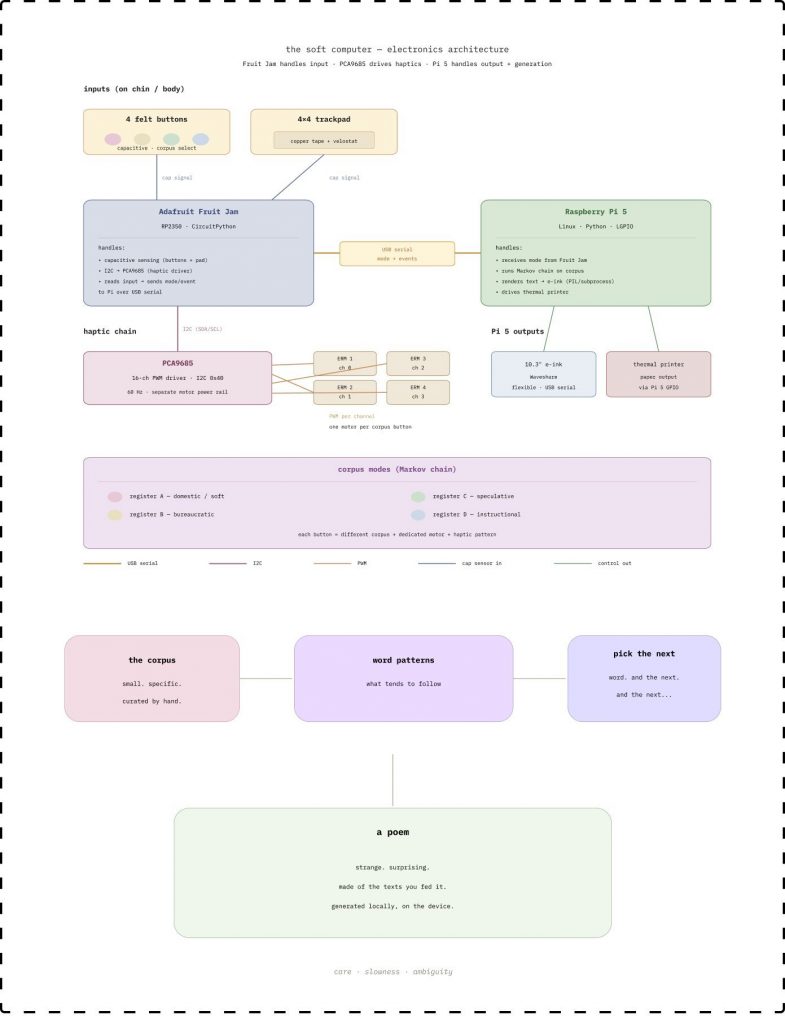
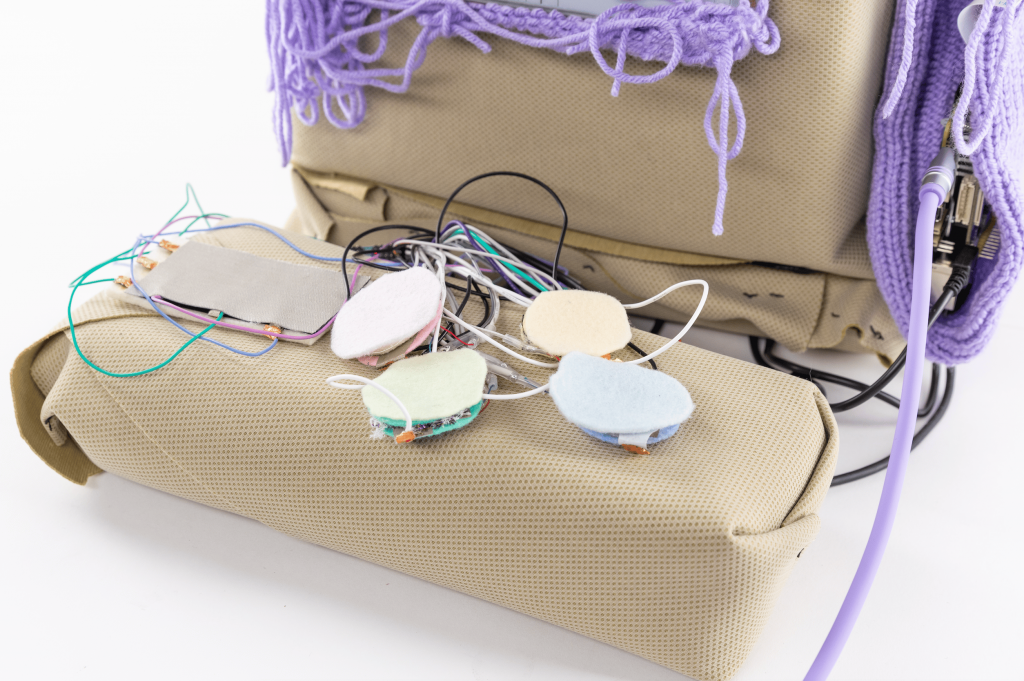
Four felt buttons act as a poetic keyboard, each one steering a generative text engine toward a different body of writing. A soft trackpad shifts the mood of the language. Poems accumulate slowly on the screen in response to touch, unhurried, material, present.
The Soft Computer draws on the long history of textiles and computing as entangled practices: the Jacquard loom as proto-program, the punch card as woven instruction. It asks what computing might look like if it inherited not just the logic of the loom but its texture, its slowness, its care.
This project proposes softness not as a limitation but as a design stance, against optimization, against command, against the assumption that faster and more efficient is always better. It is a speculative object and a functional one: a computer that generates poetry instead of productivity, that responds to presence instead of input.
What can a soft computer do that a hard computer never could? What becomes possible when we design computers around softness rather than hardness, around care rather than command?
Technical Details
Software & Systems: Python and CircuitPython-based development including sensing, haptics, NeoPixel control, and audio output; generative text engine using multiple curated datasets; custom USB serial communication pipeline; system configuration and integration on embedded hardware (e.g., Raspberry Pi); e-ink display setup requiring GPIO and external power, with restart cycles between runs.
Fabrication: Carved upholstery foam body construction with internal chassis, Soft materials outer enclosure (neoprene, industrial felt, cotton batting), machine-knit accent panel (screen frame), Felt snap-on buttons
Form: 13" tall x 16" wide x 10" deep
Research/Context
The Soft Computer sits within several intersecting lineages. The most foundational is the historical entanglement of textiles and computing: Alexis Clairaut employed human "computers" to predict Halley's Comet (1757); the Jacquard loom introduced punched cards as pattern logic (1804); Ada Lovelace described computation through weaving metaphors (1843); six women wired and programmed ENIAC (1945); and rope core memory for the Apollo missions was woven by hand at Raytheon, predominantly by women (1960s). Lillian Schwartz's early computational art extended this lineage into aesthetics. Computation has a soft origin that was systematically erased as the field industrialized.
The theoretical frame draws from Mark Weiser and John Seely Brown's calm technology (1996), Hiroshi Ishii and Brygg Ullmer's tangible bits and embodied interaction (1997), Shaowen Bardzell's feminist HCI (2010), Steven Jackson's broken world thinking and repair culture (2014), and Olia Lialina's ongoing work arguing for the visible computer and the rights of users. The e-textiles lineage, particularly the work of Hannah Perner-Wilson (KOBAKANT), Leah Buechley's LilyPad Arduino, Irene Posch's embroidered computers, and XS Labs' reactive garments, establishes the material and technical vocabulary the project builds on.
For output, the project takes cues from Kelli Anderson's work on paper as a computational medium and the Conditional Design Workbook's approach to constraint-based generation. For text, the project draws from Allison Parrish's computational poetics practice, using lightweight generative text methods over large language models deliberately, in alignment with the project's values of interpretability and slowness. The flexible e-ink display is informed by research into plastic logic substrates and large-format flexible display technology. Malcolm McCullough's The Fabric of Interface grounds the project's thinking on tactile interaction as a serious interface philosophy.