The Period God
Xiaoxu Han
Advisor: Simone Salvo
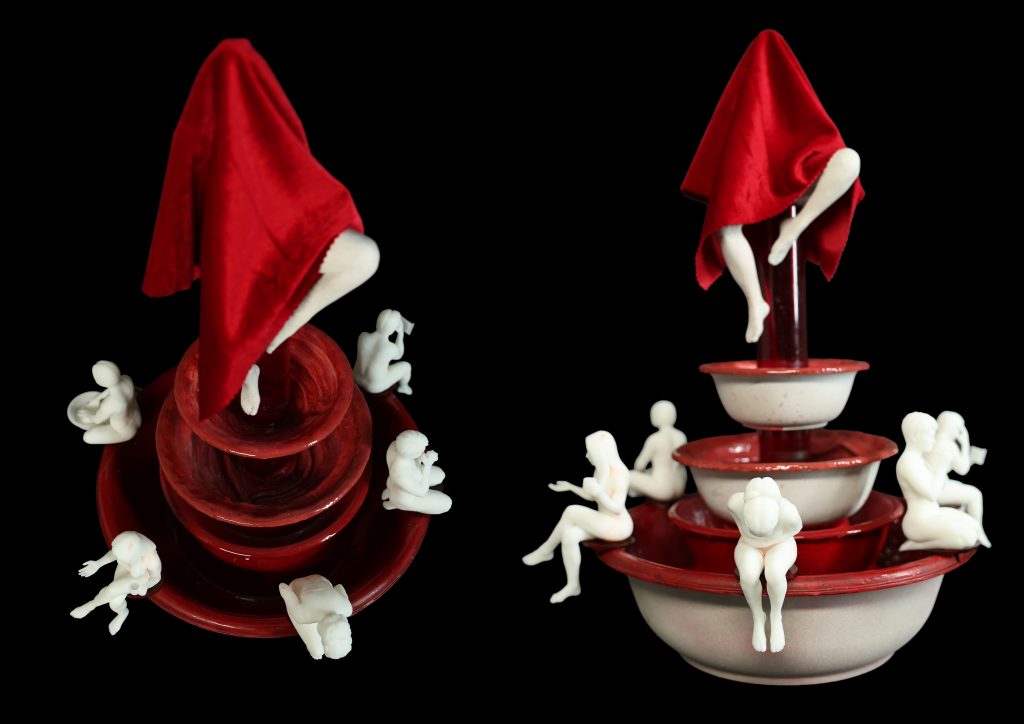
The Period God “姨妈神” is a social practice project inspired by a vernacular internet deity in China, an imagined figure believed to govern menstruation.This project explores the cultural stigma surrounding menstruation and transforms private experiences into a shared public conversation.
Project Description
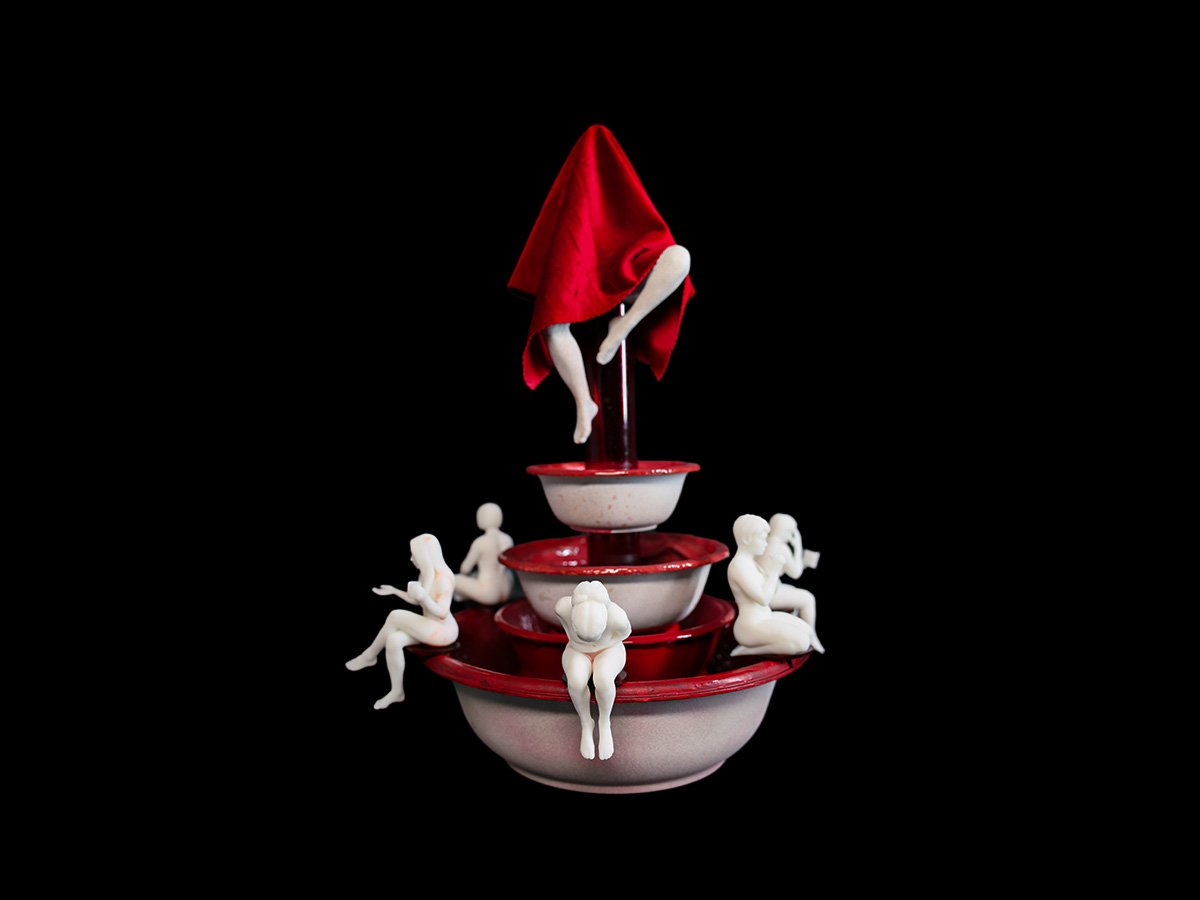
The Period God “姨妈神” is a social practice project inspired by a vernacular internet deity in China, an imagined figure believed to govern menstruation.This project explores the cultural stigma surrounding menstruation and transforms private experiences into a shared public conversation.
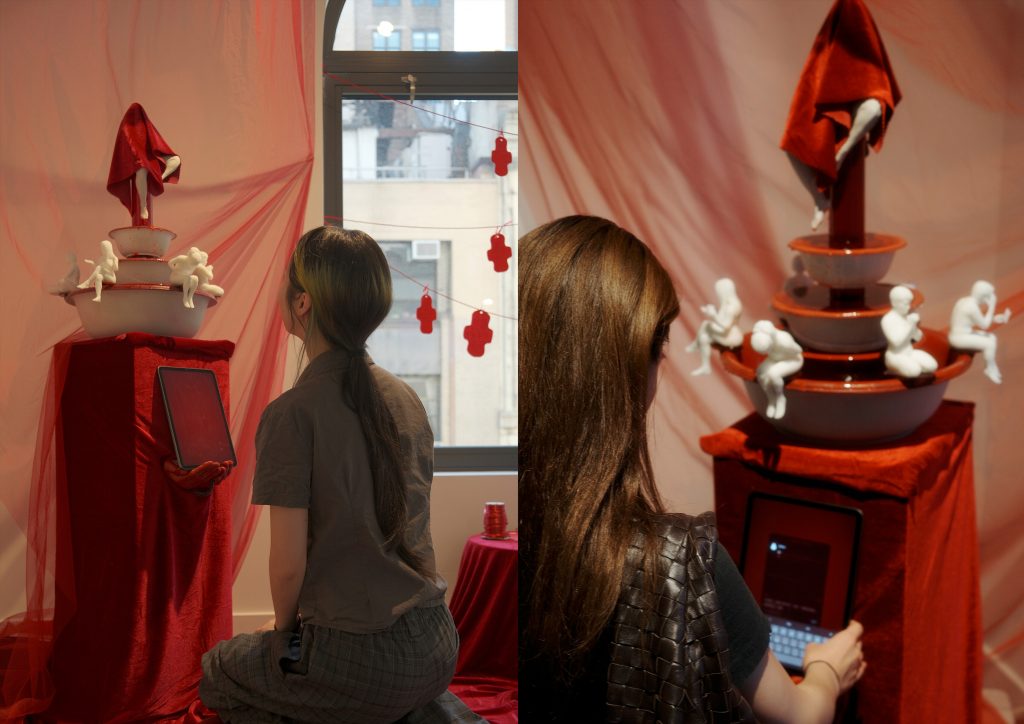
For the installation, participants kneel before a screen in a traditional posture of reverence, yet the interaction subverts religious hierarchy. Touching the digital shrine triggers a physical red fountain, revealing the deity not as a feared idol, but as an equal mirror reflecting the horizontal solidarity of the female experience.
Technical Details
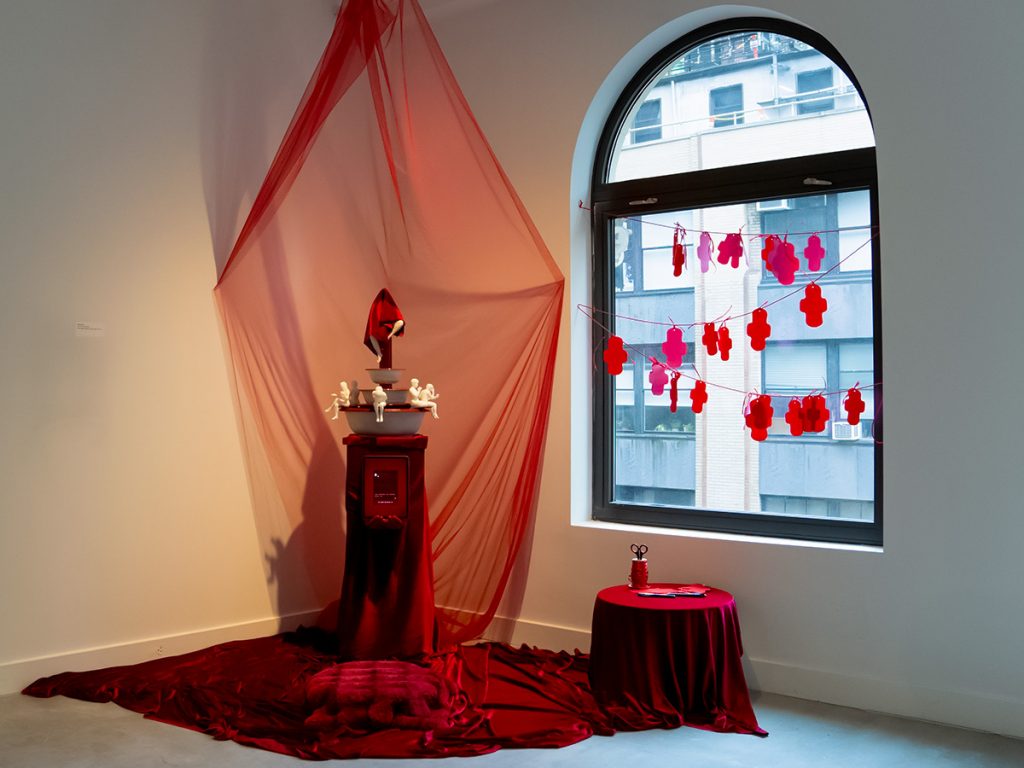
The audiences need to kneel down in fornt of the fountain and interact with the screen. The audiences need to pray and send their wishes to the period god through the fountain. The god would reply the audience with a stream of water through the fountain. After the prayer experience, the audiences would be guided to a writing table to write their wishes on a pad shape wishing card. After telling their wishes/responding to other people's wishes, they can hang the wishing cards on the wall.
Research/Context
"姨妈神" (Period God) is a vernacular spiritual being in contemporary China that has gained popularity and deity status on social media. Claimed by female internet users to have the power to bring menstruation to those whose period is delayed, “拜姨妈” (the Period God worship) is mainly active on RedNote, Weibo, and Douban. Female users worship the Period God on social media by posting images or simply calling upon its name, hoping their period will arrive soon.
It is important to highlight that the worship of the Period God on social media is a circular and reciprocal action. Girls who get their period after worshiping the Period God will, in return, "send" their period to others by submitting a new post or comment. Other girls will then comment “接姨妈” (which means "pick up the period") to receive the luck and pass it forward.
Based on preliminary digital participant observation, females engaging in this spiritual practice can be classified into two groups: First, those who fear pregnancy and wish for their period to arrive on time. Second, those who experience gynecological or mental health issues that lead to irregular menstruation and hope for a timely period. Interestingly, some males also comment under posts on behalf of their girlfriends, asking for the Period God's help.
There is no concrete visual depiction of the Period God—its appearance, gender, sexuality, race, and ethnicity remain undefined. Instead, it exists as an abstract, conceptual, and mysterious being, allowing for individual interpretations. Some girls, for example, regard a Chinese male celebrity as the Period God, justifying this by saying that whenever they worry about their period not coming, watching his videos or attending his concerts coincidentally causes their period to arrive.
The word "姨妈" (auntie) is a euphemism for menstruation. Because menstruation is stigmatized in Chinese culture (as well as in many other cultures), using alternative terms makes it less sensitive. The name "姨妈神" (Period God) itself reflects the ongoing stigmatization of menstruation.
Emphasizing the term "worship," it is important to highlight its epistemological roots in Christianity. In Western religions, God is an authority figure, and worship typically implies an unequal relationship between the deity and the worshipper. In contrast, the Period God embodies a more transactional and reciprocal interaction. In simple terms, the relationship between the Period God and its ritual practitioners can be summarized as: "I believe in your power, which is why I engage with you. But if I worship you and nothing happens, I will stop engaging with you." This is fundamentally different from a believer’s relationship with a deity, which is normally not reciprocal or equal. Most importantly, menstruation is a natural part of the female body and inseparable from it. The deity coexists with its practitioners.