https://yuqianma.github.io/ce-salt/
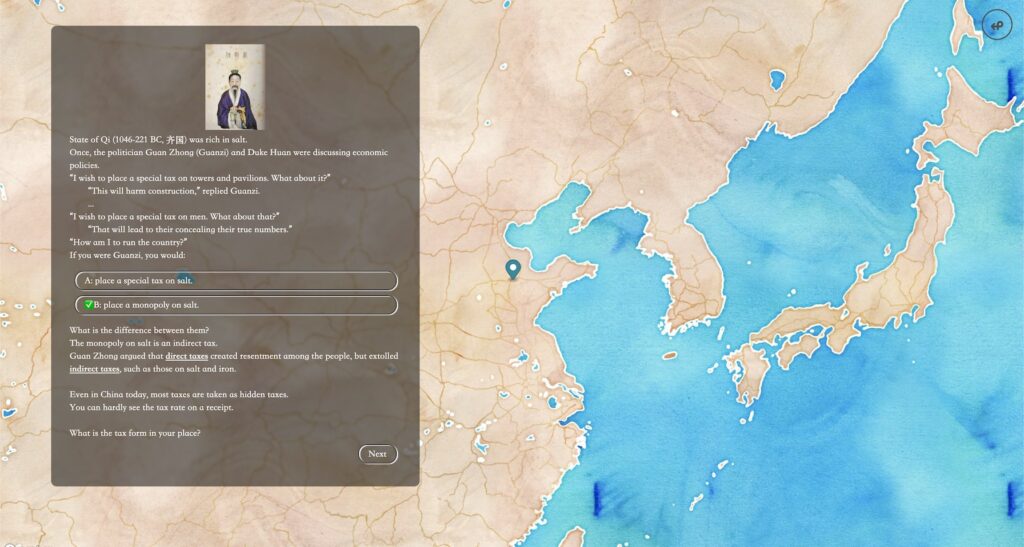
Finally I made a simple page with 3 questions on top of the map. I wish I didn’t use so many words on the page but so far it is like this.
There are so many directions of my topic “salt”. Found my pin-point just a week ago. Ideas are still changing during this week. So things are a little rough.
The intention of this guide is to show how salt related ancient economic policies impact the economic policies today. The original design including borders on the map and other images to present a more engaged story. However I haven’t had time to build a good story. So I choose three events about salt and set questions to encourage users to follow my thoughts.
It represents three roles of salt in ancient history:
- a form of tax
- a tool of fiscal policy
- a weapon in the trade war
Stakeholders in the system are people, government and other countries.
The metaphor I planned to do was taking salt as power and the government was like chef. It comes from Tao Te Ching: “Governing a great nation is like cooking a small fish” (治大国,若烹小鲜)
The guide should be narrowed down to a more specific topic. But it is a good beginning for me to think in that way.
The process
The topic “salt” is a daily thing thus it has a lot of possible angles. Considering the theme “border”, I tended to choose topics related to economy and trade. But I didn’t find the pin-point topic.
Then I had a talk with Monika, she encouraged me to find things matter myself. I decide to focus on history, especiall Chinese history. Monika also introduced a form of book called “Choose Your Own Adventure”, which is a story but with different branches.
Stories I collected are:
And after I read a hypothesis that the Huns and the Xiongnu are the same ethnic group, one story branch comes to my mind: Han defeated Xiongnu – Xiongnu(Huns) migrated to Europe – collapse of the Roman Empire. It builds relations between East and West history, which is so imaginative.
The branches drafted:
Imagine the different possibilities of history is fun. However, there is one problem hindered me: the fun comes from rational hypothesis. But I was lost in these derived questions.
So I decide to build a relative simple guide now. One aspect impressed me: the economic policies in the history are similar to what we have today.
Questions in the guide:
What is the tax form in your place?
Have you seen similar economic policies? (control the price)
Do you know other economic wars? What are weapons there?
Do you know other legacies of ancient economic policies?
What has as much impact as salt today?
Questions of the guide:
What specific story or angle you would like to choose to expand?
What metaphors you’d have?
Bibliography
I love the tone and interactions of this guide. Visually it is beautiful, moreover it seems to take us back to the China ancient times. I also like the Q&A /Quiz as a format for interaction – clear, straightforward and informative. The relationship between salt and economy is a good topic for deep-dive. Besides Ancient China, I would love to see the impact of salt, (or other seasoner, e.g.: sugar, spice) in other regions or countries. And I believe the comparison among them will be also fun!
GREAT JOB! The outcomes are fantastic, I can see the amount of work and effort you put in, well done!
Reading through the documentation, I am fascinated by the idea that you originally wanted to create some linear narratives around this topic. The fact that “salt” as such a basic need for daily usage would have become a political and economic tool under a centralistic setting provides a broader scope of the ancient monarchy.
I also begin wondering what are the equivalents of “salt and iron” in a contemporary setting are and how the equivalents play their roles in current political or economical settings.