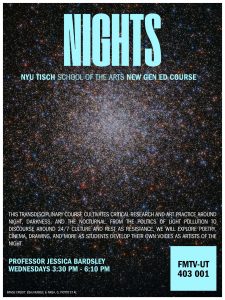
The emerging, interdisciplinary field of “nyctology,” or the study of night and the nocturnal, is increasingly a source of inspiration and inquiry for artists. This interdisciplinary course cultivates critical research and art practice around night, darkness, and the nocturnal in dialogue with this emerging field. From the use of darkness as a technology to night’s status as an endangered environment, this course interweaves readings from areas including art history, cultural astronomy, Black studies, conservation science, media studies, Indigenous studies, and the celestial humanities, along with critical discussions about the somatic and psychological effects of grind culture and overwork. We will consider the politics of light pollution, nocturnal ecologies, and the growing DarkSky Movement; discourse around 24/7 culture and rest as resistance; as well as Take Back the Night, race and surveillance; and queer cruising. Along the way, we will encounter poetry, cinema, drawing, installation, music and other genres of art as students develop critical research skills while also developing their own voices as artists. less description for FMTV-UT 403 «
Tisch School of the Arts
Spring 2027
|
FMTV-UT 403 | 4 units
Class#: 22098
Session: 1 01/19/2027 – 05/04/2027
Section: 001
Class Status: Open
Grading: Ugrd Tisch Graded
Instruction Mode: In-Person
Course Location: Washington Square
Component: Seminar
01/19/2027 – 05/04/2027 Wed 3.30 PM – 6.10 PM |