Category Archives: Spring 2027

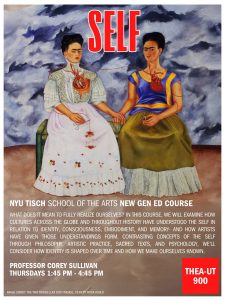
THEA-UT 900 Self

What does it mean to fully realize ourselves? In this course, we will examine how cultures across the globe and throughout history have understood the self in relation to identity, consciousness, embodiment, and memory—and how artists have given those understandings form. Exploring contrasting concepts of the self across philosophy, sacred text, psychology, and artistic practice, we’ll consider how identity is shaped over time and how we make ourselves known. Assignments will combine textual analysis and research with transdisciplinary approaches to portraiture as we seek new ways of discovering, understanding, and representing ourselves. Although we will explore these ideas in a variety of formats (including performance, photography, film, and music), no previous experience is necessary, and students from all Tisch majors are encouraged to enroll. Satisfies General Education: Social & Natural Science. less description for THEA-UT 900 «

School:

Tisch School of the Arts

Term:

Spring 2027

THEA-UT 900 | 4 units
Class#: 22139
Session: 1 01/19/2027 – 05/04/2027
Section: 001
Class Status: Open
Grading: Ugrd Tisch Graded
Instruction Mode: In-Person
Course Location: Washington Square
Component: Lecture

01/19/2027 – 05/04/2027 Thu 1.45 PM – 4.45 PM
Notes: This section is open to all students throughout Tisch. This class is a Gen Ed Social Science.

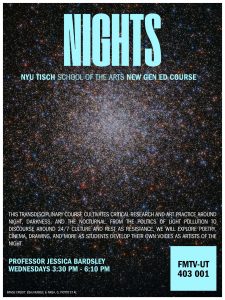
FMTV-UT 403 Nights

The emerging, interdisciplinary field of “nyctology,” or the study of night and the nocturnal, is increasingly a source of inspiration and inquiry for artists. This interdisciplinary course cultivates critical research and art practice around night, darkness, and the nocturnal in dialogue with this emerging field. From the use of darkness as a technology to night’s status as an endangered environment, this course interweaves readings from areas including art history, cultural astronomy, Black studies, conservation science, media studies, Indigenous studies, and the celestial humanities, along with critical discussions about the somatic and psychological effects of grind culture and overwork. We will consider the politics of light pollution, nocturnal ecologies, and the growing DarkSky Movement; discourse around 24/7 culture and rest as resistance; as well as Take Back the Night, race and surveillance; and queer cruising. Along the way, we will encounter poetry, cinema, drawing, installation, music and other genres of art as students develop critical research skills while also developing their own voices as artists. less description for FMTV-UT 403 «

School:

Tisch School of the Arts

Term:

Spring 2027

FMTV-UT 403 | 4 units
Class#: 22098
Session: 1 01/19/2027 – 05/04/2027
Section: 001
Class Status: Open
Grading: Ugrd Tisch Graded
Instruction Mode: In-Person
Course Location: Washington Square
Component: Seminar

01/19/2027 – 05/04/2027 Wed 3.30 PM – 6.10 PM
Notes: Course allocates as General Education. The emerging, interdisciplinary field of “nyctology,” or the study of night and the nocturnal, is increasingly a source of inspiration and inquiry for artists. This interdisciplinary course cultivates critical research and art practice around night, darkness, and the nocturnal in dialogue with this emerging field. From the use of darkness as a technology to night’s status as an endangered environment, this course interweaves readings from areas including art history, cultural astronomy, Black studies, conservation science, media studies, Indigenous studies, and the celestial humanities, along with critical discussions about the somatic and psychological effects of grind culture and overwork.

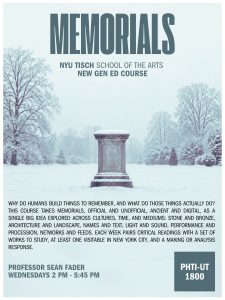
PHTI-UT 1800 Memorials

Why do humans build things to remember, and what do those things actually do? This course takes memorials, official and unofficial, ancient and digital, as a single big idea explored across cultures, across time, and across mediums: stone and bronze, architecture and landscape, names and text, light and sound, performance and procession, networks and feeds. Research and making go hand in hand. Each week pairs critical readings from history, anthropology, sociology, geography, and law with a set of works to study, at least one visitable in New York City, and a making or analysis response. The class begins with three weeks of destabilizing questions (What is a memorial? Who gets remembered? Should monuments fall?), moves through a survey built on architect Michael Murphy’s taxonomy of memorials that mark, provoke, evoke, and immerse, extended to the performed, the earthen, and the dispersed, and ends in a studio: each student researches, designs, and stages a memorial of their own, physical or ephemeral, presented to an invited public in a final convening. Weekly guests from the field, designers, artists, producers, scholars, and activists who have built the memorials we study, join throughout. New York City is our laboratory; expect site visits and fieldwork. less description for PHTI-UT 1800 «

School:

Tisch School of the Arts

Term:

Spring 2027

PHTI-UT 1800 | 4 units
Class#: 23177
Session: 1 01/19/2027 – 05/04/2027
Section: 001
Class Status: Open
Grading: Ugrd Tisch Graded
Instruction Mode: In-Person
Course Location: Washington Square
Component: Lecture

01/19/2027 – 05/04/2027 Wed 2.00 PM – 5.45 PM
Notes: Why do humans build things to remember, and what do those things actually do? This course takes memorials, official and unofficial, ancient and digital, as a single big idea explored across cultures, across time, and across mediums: stone and bronze, architecture and landscape, names and text, light and sound, performance and procession, networks and feeds. Research and making go hand in hand. Each week pairs critical readings from history, anthropology, sociology, geography, and law with a set of works to study, at least one visitable in New York City, and a making or analysis response. The class begins with three weeks of destabilizing questions (What is a memorial? Who gets remembered? Should monuments fall?), moves through a survey built on architect Michael Murphy’s taxonomy of memorials that mark, provoke, evoke, and immerse, extended to the performed, the earthen, and the dispersed, and ends in a studio: each student researches, designs, and stages a memorial of their own, physical or ephemeral, presented to an invited public in a final convening. Weekly guests from the field, designers, artists, producers, scholars, and activists who have built the memorials we study, join throughout. New York City is our laboratory; expect site visits and fieldwork.

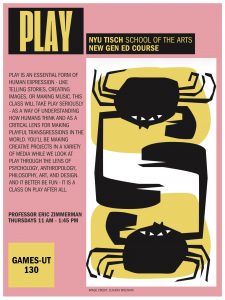
GAMES-UT 130 Play

This hybrid making + thinking course will look at the phenomenon of play from multiple perspectives, including psychology, anthropology, philosophy, and as a form of expression in art and design. We will leverage insights from these perspectives to critically analyze play in culture and to apply them to projects across many artistic disciplines. We will be exploring questions like What is play and how does it inform art and design? How does play manifest across forms of cultural expression and artistic disciplines? What would it mean to be more playful and how would it impact our own artistic practices? Students from every department at Tisch are welcome to come and take part. less description for GAMES-UT 130 «

School:

Tisch School of the Arts

Term:

Spring 2027

GAMES-UT 130 | 4 units
Class#: 22131
Session: 1 01/19/2027 – 05/04/2027
Section: 001
Requires Department Consent
Class Status: Open
Grading: Ugrd Tisch Graded
Instruction Mode: In-Person
Course Location: Brooklyn Campus
Component: Studio

01/19/2027 – 05/04/2027 Thu 11.00 AM – 1.45 PM
Notes: Game Center Majors, Minors, and non-GC students must complete the following form – https://forms.gle/VNeaaH73jh11xXTg8 – and will be added to the class in the order of submitted forms. There is a media fee for this course.

EDCT-UE 1043 Your Brain on AI: Well-Being in the Digital Age

4 credit course Tuesdays from 11:00AM – 12:15PM
 
Review the digital brochure and more information below: 
 

Artificial intelligence is no longer just a tool—it’s becoming part of how we think. This new course explores a simple but urgent question: How is AI changing your mind—and is that a good thing? From writing essays to making decisions, from scrolling feeds to forming relationships, AI is reshaping attention, memory, learning, creativity, and judgment. This course helps you understand those changes—and take control of them. You won’t just learn about AI. You’ll learn how to live well with it.

What You’ll Learn

By the end of the course, you will be able to:

  • Analyze how AI affects attention, memory, and problem-solving

  • Evaluate AI use through a well-being framework (not just efficiency)

  • Design your own personal strategy for healthy AI use

  • Use AI effectively as a learning tool without losing independent thinking

  • Critique real-world systems like chatbots, recommendation algorithms, and social media

WRTNG-UG 1365 Writing Queer YA Fiction

Young adult fiction has been experiencing a boom in LGBT representation in the last ten years, expanding not only into all genres (science fiction, magical realism, historical fiction), but also across racial and socioeconomic lines. Special attention will be paid in this course to intersectionality and how themes of coming out, defining or redefining your gender identity, and navigating the LGBT landscape is affected by race, gender, and class. In addition to reading and analyzing contemporary YA texts we will also workshop students’ corresponding YA chapters and short stories. The workshop will focus on developing voice and crafting realistic dialogue, as well as the importance of world-building. Assigned readings will focus on both classic YA LGBT literature including Annie on My Mind by Nancy Garden and Boy Meets Boy By David Levithan, as well as recent additions to the cannon including The Gentleman’s Guide to Vice and Virtue By Mackenzi Lee, Everything Leads to You By Nina Lacour, They Both Die in the End By Adam Silvera and If I Was Your Girl Meredith Russo. less description for WRTNG-UG 1365 «


School:

Gallatin School of Individualized Study

Term:

Spring 2027

WRTNG-UG 1365 | 4 units
Class#: 11594
Session: 1 01/19/2027 – 05/04/2027
Section: 001
Class Status: Open
Grading: Ugrd Gallatin Graded
Instruction Mode: In-Person
Course Location: Washington Square
Component: Seminar

01/19/2027 – 05/04/2027 Tue,Thu 2.00 PM – 3.15 PM

SOC-UA 971 University Variable Topics in Sociology What We Can Do About Climate Change

Open to undergraduate students in any NYU school or discipline (no prerequisites). Courses are seven weeks long, graded Pass/Fail, and designed for students who are eager to connect across fields and explore timely topics. The topics offered by the Department of Sociology vary by semester. Students may take the course x times in total (y credits) as specific topics change.

School:
College of Arts and Science
Term:Spring 2027
Topic: What We Can Do About Climate Change
SOC-UA 971 | 1 units

Class#: 23119
Session: 7W1 01/19/2027 – 03/09/2027
Section: 001
Class Status: Open
Grading: CAS Pass/Fail
Instruction Mode: In-Person
Course Location: Washington Square
Component: Lecture

01/19/2027 – 03/09/2027 Tue 6.45 PM – 8.25 PM at 36 E 8th St (Cantor Film Ctr) Room 102 with Klinenberg, Eric
Notes: Course Repeatable for Credit.

Thesis Part 2: Production (ITPG-GT 2099)

This course focuses on the Design, User Testing, and Production of the final Thesis project. Students will meet with the Thesis Advisor bi-weekly, often in small study groups or 1:1 meetings. Prerequisite: Thesis Part 1: Research and Development.

Graduate

Universe in a Blender (OART-UT 29)

Blender is a dynamic tool that can be used to design real world sets, physical objects and virtual assets for various media and live performance. It can render robust animations and impose visual effects on recorded video. It has the capacity to interface easily with interactive softwares like Unity and Unreal, while having the potential to output hi-fidelity renders for print. But beyond that it’s just a software. The ability to create any believable world comes from you. In this class we will explore a variety of techniques to create living, breathing fictional worlds while honing the skills in Blender to bring them to life. Students will be asked to create food, buildings, clothing, people and traffic signs from their fictional universe – building consistency of aesthetic, narrative allusion, and the fine details that make any world “believable”. The class will involve dissecting and discussing media on this world building, technical tutorials and instruction in Blender, and hands on workshops that tackle the conceptual questions of world building while exploring how to interface Blender with an outside medium: (3D printing, Pattern Making, Asset Development, Unity, Unreal, After Effects, recorded video). Students will be expected to watch technical tutorials and read short pieces on these topics for homework. Students will also complete weekly deliverable assignments.

Undergraduate

Artists & Audiences in Historical Context (REMU-UT 1203)

A follow-up complement to the first-year required Creative Entrepreneurs in Historical Context course that focused on entrepreneurs and producers, Artists and Audiences in Historical Context considers the history of popular (& semi-popular) music through the lens of iconic performers/recording artists and their audiences and communities, with special attention to issues of space and geography. Here are the central questions this class asks: Why do we have performing musicians and recording artists? What work do they do in the world, and how have our conceptions of the artist changed over time? And why do artists continue to need audiences? What role do fans and listeners play in our culture and politics? As we tackle these questions, we’ll look at how artists and audiences have been impacted over the decades by emerging media and technologies; we’ll look at auteur theory, crowd theory and cultural conceptions of musical genius; we’ll address taste and the rockism/poptimism debates; the pervasive role of stardom/celebrity as it determines what we might call today’s “pop industrial complex;” we’ll talk about issues of freedom of expression and political activism; we’ll think about the artist’s role in and against forces like war, terrorism and various forms of state and religious repression; and the artist’s struggle to reach audiences in, and against, categories of classification like genre and format. Artists and Audiences in Historical Context is an intensive reading and writing course, perhaps the most intensive one you will take at REMU: students read critical and historical writing about a diverse range of performers/recording artists, and then practice critical/creative writing themselves. Working with assistant editors/mentors as well as the instructor, students will be expected to learn how music writing improves through drafting, editing and stylistic refinement. Weekly audio/video playlists will supplement the reading and writing.

Undergraduate

Communications and Technology (IMNY-UT 273)

From alphabets to virtual realities, this course will explore the development, reaction, and long term impact of various communication technologies. How have these technologies, such as writing, printing, the telegraph, television, radio, the internet and beyond, transformed society? And what changes can be observed both today and tomorrow? After students look closely at past and current future communication technologies, students will speculate on the future of communication technologies in a connected world by proposing their own transformative technology. Readings and discussion will cover communication theory, technical processes, creative applications, and critical investigation. Writing assignments will be paired with practical assignments where students will be challenged to bring their analysis and ideas to life. The web will also be utilized as a test bed for experiencing and experimenting with various forms of communication both old and new. This course will be part seminar and part lab. In the seminar portion of the class, time will be spent engaging in short lectures, critical discussions, and reviews of both reading and writing assignments. In the lab portions, students will participate in hands-on creative and technical activities and present practical assignment work. Throughout the class, students will be encouraged to learn through play, experimentation, collaboration, and exploration. Both individual and group work will be assigned.

Undergraduate

Internship (ITPG-GT 2100)

Internship can fulfill a Tier 2 (elective) requirement. An internship is done with an outside agency that provides a student with opportunities to work on projects that enable the student to develop and demonstrate his or her practical abilities, and which involve both new interactive technologies and their users.

Graduate

Intro to Television Writing (FMTV-UT 1017)

This course, aimed at second semester sophomores, is the launch pad of Television Writing in the department. Before taking any other TV writing courses, students must take Introduction To Television Writing. The course will introduce sophomores interested in TV writing to all aspects of what goes into the creation of a script for a TV program. It is also recommended for non-writers who wish to learn the fundamentals of TV writing as preparation for creating shows and working with writers. The course will also prepare students for other TV-writing courses in the departmental Television Progression. The course is also open to seniors with an interest in television writing who haven’t taken other TV writing courses. This course allocates as Film & TV, Scriptwriting for Film & TV majors.

Undergraduate

Topics in ITP: Creative Image Generation Creative Image Generation (ITPG-GT 2378)

This course will cover a variety of academic topics within the field of Interactive Telecommunications. For further details, please refer to the individual class section notes and topic subtitle.

Graduate

Class titles vary by section.

Topics in ITP: Disturbing Code Disturbing Code (ITPG-GT 2379)

This course will cover a variety of academic topics within the field of Interactive Telecommunications. For further details, please refer to the individual class section notes and topic subtitle.

Graduate

Class titles vary by section.

Universe in a Blender (COART-UT 508)

Blender is a dynamic tool that can be used to design real world sets, physical objects and virtual assets for various media and live performance. It can render robust animations and impose visual effects on recorded video. It has the capacity to interface easily with interactive softwares like Unity and Unreal, while having the potential to output hi-fidelity renders for print. But beyond that it’s just a software. The ability to create any believable world comes from you. In this class we will explore a variety of techniques to create living, breathing fictional worlds while honing the skills in Blender to bring them to life. Students will be asked to create food, buildings, clothing, people and traffic signs from their fictional universe – building consistency of aesthetic, narrative allusion, and the fine details that make any world “believable”. The class will involve dissecting and discussing media on this world building, technical tutorials and instruction in Blender, and hands on workshops that tackle the conceptual questions of world building while exploring how to interface Blender with an outside medium: (3D printing, Pattern Making, Asset Development, Unity, Unreal, After Effects, recorded video). Students will be expected to watch technical tutorials and read short pieces on these topics for homework. Students will also complete weekly deliverable assignments.

Undergraduate

Ecology of New York Theater (THEA-UT 679)

New York City is celebrated in the English speaking world as a center of theatrical production, making a consequential contribution to the culture. The sheer volume, range and scope of activity can make the theater scene challenging to navigate, especially as an emerging professional. The course “Ecology of New York Theater” unpacks the power structures, operating systems and business models currently underpinning the live theater industry. From the commercial theater to not-for-profit companies to presenting organizations and festivals, how does each part of the sector function and where do they interact? Who are the power brokers within the current ecosystem and, perhaps more importantly, who are the influencers that are driving innovation – the makers and disrupters moving the field forward? With which producing companies, unions and institutions is it essential to become familiar as amatter of professional literacy? And who are the creatives and power brokers that are most significant in the field right now? How is new work developed in both the commercial and the not for profit theater? Who really decides what gets produced – how and why? Upon what should one rely for cultural information? Do critics still matter? What about new trends such as immersive theater, illusion, hybrid concerts, autobiographical and testimony theater, circus and burlesque? And what of the audience? What does the live experience offer – and has the responsibility of the artist toward the audience changed? Who is coming to the theater and who is not? While it will not be possible to cover every linchpin organization, company or creator, students will know how to find out what they need to know when they need to know it.

Undergraduate

Lighting: (PHTI-UT 1013)

Prerequisite: Photography II or permission from the Department. This class teaches lighting as a series of the most common lighting problems encountered in professional photography and cinematography. The course philosophy is that the most complex and difficult lighting problems are really just combinations of small, easily resolved, problems. Starting with basic three-point lighting for portraiture using simple continuous source lighting, the course will progress quickly to extremely complex set ups using electronic flash as well as lighting for the new generation of hybrid Dslr’s (video/still camera) as it moves through multiple environments. Subjects covered include: Lighting for portraits, still life, fashion, interiors, documentary, and exterior location lighting using battery powered flash. Location scouting and planning according to location limitations. Color temperature and color control. Light shaping and control. Students will learn how to use: Digital SLR’s, medium format cameras, Leaf Aptus electronic capture, direct tethered capture using Adobe Lightroom, continuous lighting, electronic flash, color temperature meters and custom white balance profiles as well as the basics of video/sound capture. Lighting equipment is provided. A lab fee is charged for this course.

Undergraduate

Useless Machines (IMNY-UT 272)

“Useless Machines is about redefining “usefulness.” Through making, we will explore what it means, on an ideological, political and historical level, to create something ‘useful’ or ‘useless.’ We will play with these definitions and explore how these objects serve to be humorous, critical, disruptive and at times… useful. We will study ‘useless’ machines throughout history, which will provoke conversations and disagreements around the implications of existing and emerging technologies. The students will design ‘useless’ machines for their final project. Examples of ‘useless’ machines are drawn from Kenji Kawakami’s The Big Bento Box of Unuseless Japanese Inventions, Dunne & Raby’s Speculative Everything, Stephanie Dinkins’ Conversations with Bina 48, https://esoteric.codes/, CW&T, Mimi Ọnụọha’s Missing Data, Jacques Carelman’s Catalogue of Impossible Objects, viral videos/objects and much more.”

Undergraduate