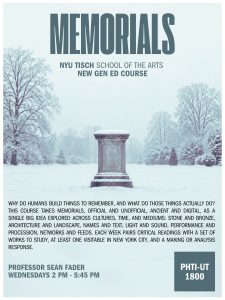
Why do humans build things to remember, and what do those things actually do? This course takes memorials, official and unofficial, ancient and digital, as a single big idea explored across cultures, across time, and across mediums: stone and bronze, architecture and landscape, names and text, light and sound, performance and procession, networks and feeds. Research and making go hand in hand. Each week pairs critical readings from history, anthropology, sociology, geography, and law with a set of works to study, at least one visitable in New York City, and a making or analysis response. The class begins with three weeks of destabilizing questions (What is a memorial? Who gets remembered? Should monuments fall?), moves through a survey built on architect Michael Murphy’s taxonomy of memorials that mark, provoke, evoke, and immerse, extended to the performed, the earthen, and the dispersed, and ends in a studio: each student researches, designs, and stages a memorial of their own, physical or ephemeral, presented to an invited public in a final convening. Weekly guests from the field, designers, artists, producers, scholars, and activists who have built the memorials we study, join throughout. New York City is our laboratory; expect site visits and fieldwork. less description for PHTI-UT 1800 «
Tisch School of the Arts
Spring 2027
|
PHTI-UT 1800 | 4 units
Class#: 23177
Session: 1 01/19/2027 – 05/04/2027
Section: 001
Class Status: Open
Grading: Ugrd Tisch Graded
Instruction Mode: In-Person
Course Location: Washington Square
Component: Lecture
01/19/2027 – 05/04/2027 Wed 2.00 PM – 5.45 PM |